


Page 378 - Handbook of Materials Failure Analysis
P. 378
376    CHAPTER 14 Fatigue failure analysis of welded structures


                                     4500
                                                                     AM30-AM60B
                                     4000
                                                                     AM60B-AZ31B
                                     3500                            AZ31B-AZ31B
                                   Load range (N)  3000


                                     2500

                                     2000

                                     1500
                                     1000
                                      1.E+03    1.E+04    1.E+05    1.E+06    1.E+07
                                                         Life (cycle)
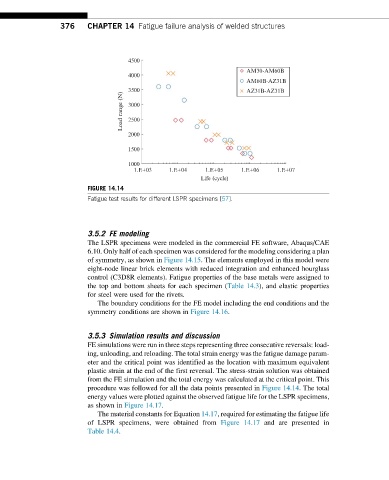
                         FIGURE 14.14
                         Fatigue test results for different LSPR specimens [57].


                         3.5.2 FE modeling
                         The LSPR specimens were modeled in the commercial FE software, Abaqus/CAE
                         6.10. Only half of each specimen was considered for the modeling considering a plan
                         of symmetry, as shown in Figure 14.15. The elements employed in this model were
                         eight-node linear brick elements with reduced integration and enhanced hourglass
                         control (C3D8R elements). Fatigue properties of the base metals were assigned to
                         the top and bottom sheets for each specimen (Table 14.3), and elastic properties
                         for steel were used for the rivets.
                            The boundary conditions for the FE model including the end conditions and the
                         symmetry conditions are shown in Figure 14.16.


                         3.5.3 Simulation results and discussion
                         FE simulations were run in three steps representing three consecutive reversals: load-
                         ing, unloading, and reloading. The total strain energy was the fatigue damage param-
                         eter and the critical point was identified as the location with maximum equivalent
                         plastic strain at the end of the first reversal. The stress-strain solution was obtained
                         from the FE simulation and the total energy was calculated at the critical point. This
                         procedure was followed for all the data points presented in Figure 14.14. The total
                         energy values were plotted against the observed fatigue life for the LSPR specimens,
                         as shown in Figure 14.17.
                            The material constants for Equation 14.17, required for estimating the fatigue life
                         of LSPR specimens, were obtained from Figure 14.17 and are presented in
                         Table 14.4.

