


Page 143 - Hydrogeology Principles and Practice
P. 143
HYDC04  12/5/05  5:36 PM  Page 126


                 126    Chapter Four


                                                             inputs to groundwater, and also for separating stream
                                                             hydrographs into components of event (rainfall) and
                                                             pre-event (soil) water (see Section 5.7.1).


                                                             4.4 Age dating of groundwater

                                                             The age of a groundwater relates to the time when
                                                             an aquifer experiences recharge and is a measure of
                                                             the groundwater residence time. The exploitation
                                                             of groundwater resources at a rate in excess of the
                                                             time to replenish the aquifer storage will risk mining
                                                             the groundwater. Hence, knowledge of the age of
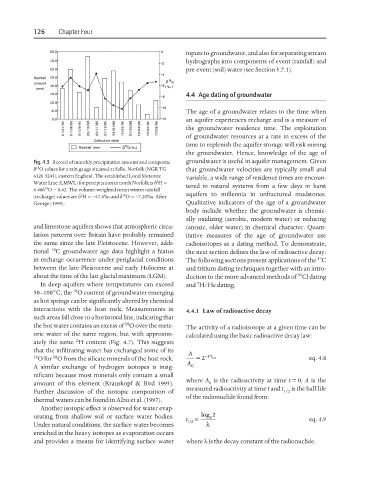
                 Fig. 4.3 Record of monthly precipitation amount and composite  groundwater is useful in aquifer management. Given
                 18
                 δ O values for a rain gauge situated at Salle, Norfolk (NGR TG  that groundwater velocities are typically small and
                 6126 3243), eastern England. The established Local Meteoric  variable, a wide range of residence times are encoun-
                 Water Line (LMWL) for precipitation in north Norfolk is δ H =
                                                     2
                    18
                 6.48δ O − 0.62. The volume-weighted mean winter rainfall  tered in natural systems from a few days in karst
                              2
                                           18
                 (recharge) values are δ H =−47.6‰ and δ O =−7.20‰. After  aquifers to millennia in unfractured mudstones.
                 George (1998).                              Qualitative indicators of the age of a groundwater
                                                             body include whether the groundwater is chemic-
                                                             ally oxidizing (aerobic, modern water) or reducing
                 and limestone aquifers shows that atmospheric circu-  (anoxic, older water) in chemical character. Quant-
                 lation patterns over Britain have probably remained  itative measures of the age of groundwater use
                 the same since the late Pleistocene. However, addi-  radioisotopes as a dating method. To demonstrate,
                      14
                 tional  C groundwater age data highlight a hiatus   the next section defines the law of radioactive decay.
                                                                                                   14
                 in recharge occurrence under periglacial conditions  The following sections present applications of the  C
                 between the late Pleistocene and early Holocene at  and tritium dating techniques together with an intro-
                 about the time of the last glacial maximum (LGM).  duction to the more advanced methods of  Cl dating
                                                                                              36
                   In deep aquifers where temperatures can exceed  and  H/He dating.
                                                                3
                            18
                 50–100°C, the  O content of groundwater emerging
                 as hot springs can be significantly altered by chemical
                 interactions with the host rock. Measurements in  4.4.1 Law of radioactive decay
                 such areas fall close to a horizontal line, indicating that
                                           18
                 the hot water contains an excess of  O over the mete-  The activity of a radioisotope at a given time can be
                 oric water of the same region, but with approxim-  calculated using the basic radioactive decay law:
                             2
                 ately the same  H content (Fig. 4.7). This suggests
                 that the infiltrating water has exchanged some of its  A
                                                                    /
                 16   18                                        =  − tt 12/
                  O for  O from the silicate minerals of the host rock.     2                    eq. 4.8
                 A similar exchange of hydrogen isotopes is insig-      A 0
                 nificant because most minerals only contain a small
                                                             where A is the radioactivity at time t = 0, A is the
                 amount of this element (Krauskopf & Bird 1995).    0
                                                             measured radioactivity at time t and t  is the half-life
                 Further discussion of the isotopic composition of                       1/2
                                                             of the radionuclide found from:
                 thermal waters can be found in Albu et al. (1997).
                   Another isotopic effect is observed for water evap-
                 orating from shallow soil or surface water bodies.  t =    log e 2              eq. 4.9
                                                              /
                 Under natural conditions, the surface water becomes       12  λ
                 enriched in the heavy isotopes as evaporation occurs
                 and provides a means for identifying surface water  where λ is the decay constant of the radionuclide.

