


Page 316 - Instrumentation Reference Book 3E
P. 316
300 Temperature measurement

            in perfect register. The orientation of one layer of   tively  with  the  incident  ray  and  the  sandwich
            molecules lies twisted by a small angle compared   looks opaque. In (b), however, the liquid crystal
            to the layer below. This helical structure rotates   is  above  the  temperature  at  which  the  ordered
            the plane of polarization of light passing through   structure  breaks  up.  The  material  is  no  longer
            the  liquid  in  a  direction  perpendicular  to  the   optically  active,  and  the  light  ray  is  reflected
            layers of molecules. Figure  14.68 illustrates  this   back  in  the  normal  way-the   material  looks
            effect diagrammatically. The optical effect is very   transparent.
            pronounced. the rotation of polarization being of   The  temperature  at  which  the  ordered
            the order of 1000" per millimeter of path length.   structure  breaks  up  is  a  function  of  the  exact
            The laminar structure  can be enhanced  by  con-   molecular  structure.  Using  polarized  light  a
            fining the cholesteric liquid between two parallel   noticeable  change  in  reflected  light  occurs  for
            sheets of suitable plastic. The choice of polymer   a temperature change of 0.001 "C. In white light
            for  this  plastic  is  based  on  two  prime  require-   the  effect  occurs  within  a  temperature  range
            ments.  First,  it  is  required  to  be  transparent to   of  0.1 "C. Both  the  appearance  of  the  effect
            light, and second, it should be slightly chemically   and  the  exact  temperature  at  which  it  occurs
            active so that  the  liquid  crystal molecules adja-   can  be  affected  by  addition  of  dyes  or  other
            cent to the surface of the polymer are chemically   materials.
            bonded to it with their axes having the required
            orientation.                              14.7.3.4  Tlzennnl imaging
              When  used  for temperature  measurement  the
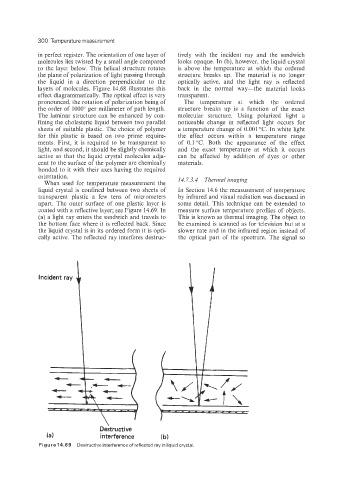
            liquid  crystal  is  confined  between two  sheets of   In Section 14.6 the measurement  of temperature
            transparent  plastic  a  few  tens  of  micrometers   by infrared and visual radiation was discussed in
            apart. The  outer  surface of  one plastic layer  is   some detail.  This  technique  can  be  extended  to
            coated with a reflective layer; see Figure 14.69. In   measure surface temperature  profiles of objects.
            (a) a light ray enters the sandwich and travels to   This is known as thermal imaging. The object to
            the bottom face where it is reflected back. Since   be examined is scanned as for television but at a
            the liquid crystal is in its ordered form it is opti-   slower rate and in the infrared  region instead  of
            cally active. The reflected ray interferes destruc-   the  optical  part  of  the  spectrum.  The  signal so

                                                              i


                               Destructive
               (a)             interference      (b)
             Figure 14.69  Destructive interference of reflected ray in liquid crystal

