


Page 232 -
P. 232
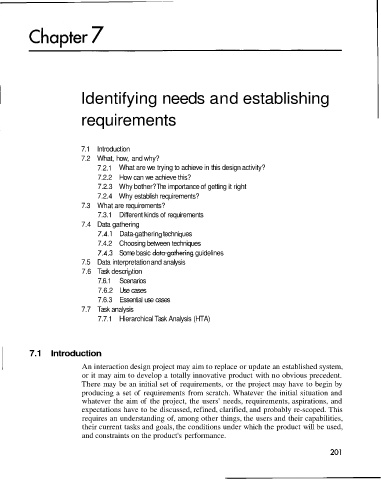
Identifying needs and establishing


                       requirements


                       7.1  Introduction
                       7.2  What, how, and why?
                            7.2.1  What are we trying to achieve in this design activity?
                            7.2.2  How can we achieve this?
                            7.2.3  Why bother? The importance of getting it right
                            7.2.4  Why establish requirements?
                        7.3  What are requirements?
                            7.3.1  Different kinds of requirements
                        7.4  Data gathering
                            7.4.1  Data-gathering  techniques
                            7.4.2  Choosing between techniques
                            7.4.3  Some basic data-gathering guidelines
                        7.5  Data interpretation and analysis
                        7.6  Task description
                            7.6.1  Scenarios
                            7.6.2  Use cases
                            7.6.3  Essential use cases
                        7.7  Task analysis
                            7.7.1  Hierarchical Task Analysis (HTA)


         7.1  Introduction

                        An interaction design project may aim to replace or update an established system,
                        or it may aim to develop a totally innovative product with no obvious precedent.
                        There may be an initial set of  requirements, or the project may have to begin by
                        producing a set of  requirements from scratch. Whatever  the initial situation and
                        whatever the aim of  the project, the users'  needs, requirements, aspirations, and
                        expectations have to be discussed, refined, clarified, and probably re-scoped. This
                        requires an understanding of, among other things, the users and their capabilities,
                        their current tasks and goals, the conditions under which the product will be used,
                        and constraints on the product's performance.

