


Page 176 - Intermediate Statistics for Dummies
P. 176
13_045206 ch08.qxd  2/1/07  10:00 AM  Page 155
                                            Chapter 8: Yes, No, Maybe So: Making Predictions by Using Logistic Regression
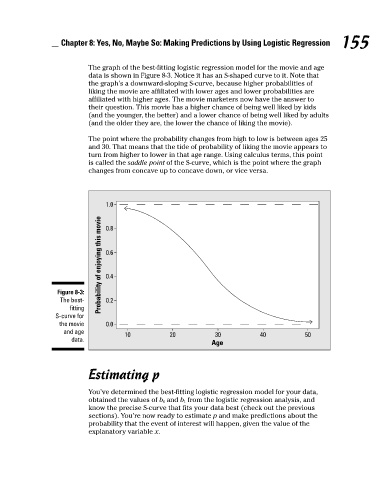
                                                    The graph of the best-fitting logistic regression model for the movie and age
                                                    data is shown in Figure 8-3. Notice it has an S-shaped curve to it. Note that
                                                    the graph’s a downward-sloping S-curve, because higher probabilities of
                                                    liking the movie are affiliated with lower ages and lower probabilities are
                                                    affiliated with higher ages. The movie marketers now have the answer to
                                                    their question. This movie has a higher chance of being well liked by kids
                                                    (and the younger, the better) and a lower chance of being well liked by adults
                                                    (and the older they are, the lower the chance of liking the movie).
                                                    The point where the probability changes from high to low is between ages 25
                                                    and 30. That means that the tide of probability of liking the movie appears to
                                                    turn from higher to lower in that age range. Using calculus terms, this point
                                                    is called the saddle point of the S-curve, which is the point where the graph
                                                    changes from concave up to concave down, or vice versa.
                                                        1.0                                                               155
                                                       Probability of enjoying this movie  0.6
                                                        0.8
                                                        0.4
                                           Figure 8-3:
                                            The best-   0.2
                                              fitting
                                          S-curve for
                                           the movie    0.0
                                             and age
                                                              10          20           30          40           50
                                               data.
                                                                                      Age
                                                    Estimating p


                                                    You’ve determined the best-fitting logistic regression model for your data,
                                                    obtained the values of b 0 and b 1 from the logistic regression analysis, and
                                                    know the precise S-curve that fits your data best (check out the previous
                                                    sections). You’re now ready to estimate p and make predictions about the
                                                    probability that the event of interest will happen, given the value of the
                                                    explanatory variable x.

