


Page 386 - Introduction to Information Optics
P. 386
7.2. Recognition by Correlation Detections


                           (a)


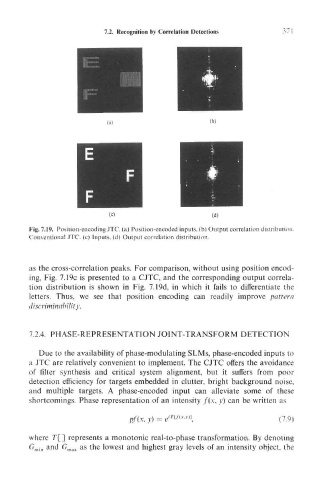
       Fig. 7.19. Position-encoding JTC. (a) Position-encoded inputs, (b) Output correlation distribution.
       Conventional JTC. (c) Inputs, (d) Output correlation distribution.


       as the cross-correlation peaks. For comparison, without using position encod-
       ing, Fig. 7.19c is presented to a CJTC, and the corresponding output correla-
       tion distribution is shown in Fig. 7.19d, in which it fails to differentiate the
       letters. Thus, we see that position encoding can readily improve pattern
       dlscnminabilit}'.


       7.2.4. PHASE-REPRESENTATION JOINT-TRANSFORM DETECTION

         Due to the availability of phase-modulating SLMs, phase-encoded inputs to
       a JTC are relatively convenient to implement. The CJTC offers the avoidance
       of filter synthesis and critical system alignment, but it suffers from poor
       detection efficiency for targets embedded in clutter, bright background noise,
       and multiple targets. A phase-encoded input can alleviate some of these
       shortcomings. Phase representation of an intensity /(x, y) can be written as

                                                                      (7.9)

       where T\_ ] represents a monotonic real-to-phase transformation. By denoting
                    as the lowest and highest gray levels of an intensity object, the
       G min and G max

