


Page 611 - Introduction to Information Optics
P. 611
10.3. Distributed Fiber-Optic Sensors
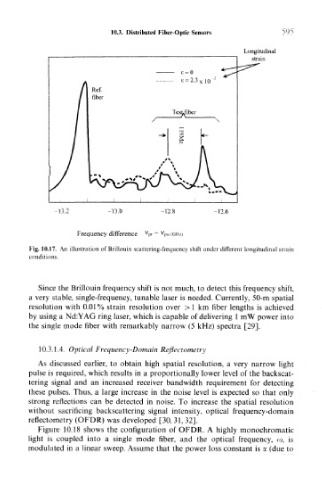
                                                              Longitudinal
                                                               strain


                           -13.0                      -12.6

                                         v
                   Frequency difference  v pr ~ pu (GHZ)
       Fig. 10.17. An illustration of Brillouin scattering-frequency shift under different longitudinal strain
       conditions.


         Since the Brillouin frequency shift is not much, to detect this frequency shift,
       a very stable, single-frequency, tunable laser is needed. Currently, 50-m spatial
       resolution with 0.01% strain resolution over > 1 km fiber lengths is achieved
       by using a Nd:YAG ring laser, which is capable of delivering 1 mW power into
       the single mode fiber with remarkably narrow (5 kHz) spectra [29].

          10.3.1.4. Optical Frequency-Domain Reflectometry

         As discussed earlier, to obtain high spatial resolution, a very narrow light
       pulse is required, which results in a proportionally lower level of the backseat-
       tering signal and an increased receiver bandwidth requirement for detecting
       these pulses. Thus, a large increase in the noise level is expected so that only
       strong reflections can be detected in noise. To increase the spatial resolution
       without sacrificing backscattering signal intensity, optical frequency-domain
       reflectometry (OFDR) was developed [30, 31,32].
         Figure 10.18 shows the configuration of OFDR. A highly monochromatic
       light is coupled into a single mode fiber, and the optical frequency, ox is
       modulated in a linear sweep. Assume that the power loss constant is a (due to

