


Page 173 - Introduction to Mineral Exploration
P. 173
156   C.J. MOON


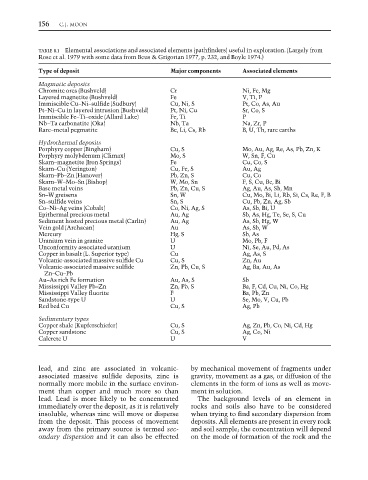
                  TABLE 8.1 Elemental associations and associated elements (pathfinders) useful in exploration. (Largely from
                  Rose et al. 1979 with some data from Beus & Grigorian 1977, p. 232, and Boyle 1974.)

                  Type of deposit                       Major components     Associated elements
                  Magmatic deposits
                  Chromite ores (Bushveld)              Cr                   Ni, Fe, Mg
                  Layered magnetite (Bushveld)          Fe                   V, Ti, P
                  Immiscible Cu–Ni–sulfide (Sudbury)     Cu, Ni, S            Pt, Co, As, Au
                  Pt–Ni–Cu in layered intrusion (Bushveld)  Pt, Ni, Cu       Sr, Co, S
                  Immiscible Fe–Ti–oxide (Allard Lake)  Fe, Ti               P
                  Nb–Ta carbonatite (Oka)               Nb, Ta               Na, Zr, P
                  Rare–metal pegmatite                  Be, Li, Cs, Rb       B, U, Th, rare earths
                  Hydrothermal deposits
                  Porphyry copper (Bingham)             Cu, S                Mo, Au, Ag, Re, As, Pb, Zn, K
                  Porphyry molybdenum (Climax)          Mo, S                W, Sn, F, Cu
                  Skarn–magnetite (Iron Springs)        Fe                   Cu, Co, S
                  Skarn–Cu (Yerington)                  Cu, Fe, S            Au, Ag
                  Skarn–Pb–Zn (Hanover)                 Pb, Zn, S            Cu, Co
                  Skarn–W–Mo–Sn (Bishop)                W, Mo, Sn            F, S, Cu, Be, Bi
                  Base metal veins                      Pb, Zn, Cu, S        Ag, Au, As, Sb, Mn
                  Sn–W greisens                         Sn, W                Cu, Mo, Bi, Li, Rb, Si, Cs, Re, F, B
                  Sn–sulfide veins                       Sn, S                Cu, Pb, Zn, Ag, Sb
                  Co–Ni–Ag veins (Cobalt)               Co, Ni, Ag, S        As, Sb, Bi, U
                  Epithermal precious metal             Au, Ag               Sb, As, Hg, Te, Se, S, Cu
                  Sediment hosted precious metal (Carlin)  Au, Ag            As, Sb, Hg, W
                  Vein gold (Archaean)                  Au                   As, Sb, W
                  Mercury                               Hg, S                Sb, As
                  Uranium vein in granite               U                    Mo, Pb, F
                  Unconformity associated uranium       U                    Ni, Se, Au, Pd, As
                  Copper in basalt (L. Superior type)   Cu                   Ag, As, S
                  Volcanic-associated massive sulfide Cu  Cu, S               Zn, Au
                  Volcanic-associated massive sulfide    Zn, Pb, Cu, S        Ag, Ba, Au, As
                    Zn–Cu–Pb
                  Au–As rich Fe formation               Au, As, S            Sb
                  Mississippi Valley Pb–Zn              Zn, Pb, S            Ba, F, Cd, Cu, Ni, Co, Hg
                  Mississippi Valley fluorite            F                    Ba, Pb, Zn
                  Sandstone-type U                      U                    Se, Mo, V, Cu, Pb
                  Red bed Cu                            Cu, S                Ag, Pb
                  Sedimentary types
                  Copper shale (Kupferschiefer)         Cu, S                Ag, Zn, Pb, Co, Ni, Cd, Hg
                  Copper sandstone                      Cu, S                Ag, Co, Ni
                  Calcrete U                            U                    V


                  lead, and zinc are associated in volcanic-  by mechanical movement of fragments under
                  associated massive sulfide deposits, zinc is  gravity, movement as a gas, or diffusion of the
                  normally more mobile in the surface environ-  elements in the form of ions as well as move-
                  ment than copper and much more so than      ment in solution.
                  lead. Lead is more likely to be concentrated  The background levels of an element in
                  immediately over the deposit, as it is relatively  rocks and soils also have to be considered
                  insoluble, whereas zinc will move or disperse  when trying to find secondary dispersion from
                  from the deposit. This process of movement  deposits. All elements are present in every rock
                  away from the primary source is termed sec-  and soil sample; the concentration will depend
                  ondary dispersion and it can also be effected  on the mode of formation of the rock and the

