


Page 174 - Introduction to Mineral Exploration
P. 174
8: EXPLORATION GEOCHEMISTRY  157


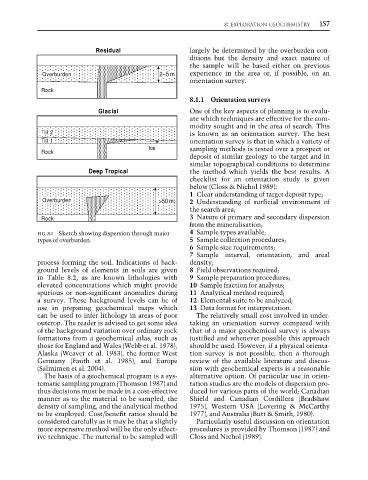
                                   Residual                   largely be determined by the overburden con-
                                                              ditions but the density and exact nature of
                                                              the sample will be based either on previous
                   Overburden                        2–5 m    experience in the area or, if possible, on an
                                                              orientation survey.
                   Rock
                                                              8.1.1 Orientation surveys
                                   Glacial                    One of the key aspects of planning is to evalu-
                                                              ate which techniques are effective for the com-
                                                              modity sought and in the area of search. This
                   Till 2                                     is known as an orientation survey. The best
                   Till 1                                     orientation survey is that in which a variety of
                                                  Ice         sampling methods is tested over a prospect or
                   Rock
                                                              deposit of similar geology to the target and in
                                                              similar topographical conditions to determine
                                Deep Tropical                 the method which yields the best results. A
                                                              checklist for an orientation study is given
                                                              below (Closs & Nichol 1989):
                                                              1 Clear understanding of target deposit type;
                   Overburden                        >50 m    2 Understanding of surficial environment of
                                                              the search area;
                   Rock                                       3 Nature of primary and secondary dispersion
                                                              from the mineralisation;
                 FIG. 8.1 Sketch showing dispersion through major  4 Sample types available;
                 types of overburden.                         5 Sample collection procedures;
                                                              6 Sample size requirements;
                                                              7 Sample interval, orientation, and areal
                 process forming the soil. Indications of back-  density;
                 ground levels of elements in soils are given  8 Field observations required;
                 in Table 8.2, as are known lithologies with  9 Sample preparation procedures;
                 elevated concentrations which might provide  10 Sample fraction for analysis;
                 spurious or non-significant anomalies during  11 Analytical method required;
                 a survey. These background levels can be of  12 Elemental suite to be analyzed;
                 use in preparing geochemical maps which      13 Data format for interpretation.
                 can be used to infer lithology in areas of poor  The relatively small cost involved in under-
                 outcrop. The reader is advised to get some idea  taking an orientation survey compared with
                 of the background variation over ordinary rock  that of a major geochemical survey is always
                 formations from a geochemical atlas, such as  justified and whenever possible this approach
                 those for England and Wales (Webb et al. 1978),  should be used. However, if a physical orienta-
                 Alaska (Weaver et al. 1983), the former West  tion survey is not possible, then a thorough
                 Germany (Fauth et al. 1985), and Europe      review of the available literature and discus-
                 (Salmimen et al. 2004).                      sion with geochemical experts is a reasonable
                   The basis of a geochemical program is a sys-  alternative option. Of particular use in orien-
                 tematic sampling program (Thomson 1987) and  tation studies are the models of dispersion pro-
                 thus decisions must be made in a cost-effective  duced for various parts of the world; Canadian
                 manner as to the material to be sampled, the  Shield and Canadian Cordillera (Bradshaw
                 density of sampling, and the analytical method  1975), Western USA (Lovering & McCarthy
                 to be employed. Cost/benefit ratios should be  1977), and Australia (Butt & Smith, 1980).
                 considered carefully as it may be that a slightly  Particularly useful discussion on orientation
                 more expensive method will be the only effect-  procedures is provided by Thomson (1987) and
                 ive technique. The material to be sampled will  Closs and Nichol (1989).

