


Page 176 - Introduction to Mineral Exploration
P. 176
8: EXPLORATION GEOCHEMISTRY  159


                   After the orientation survey has been con-
                 ducted the logistics of the major survey need
                 to be planned. The reader should devise a
                 checklist similar to that of Thomson (1987).
                 1 Hire field crew with appropriate experience  n                 n
                 and training;
                 2 Obtain base maps and devise simple sample                                    Concn
                 numbering scheme;                                Precise, accurate  Imprecise, accurate
                 3 Designate personnel for communication
                 with the laboratory;
                 4 Arrange quality control of laboratory;
                 5 Arrange for data handling and interpretation;  n              n
                 6 Organize archive of samples and data;
                 7 Liaise with other project staff (e.g. geophysi-
                 cists) and arrange reporting to management.
                   Reporting of geochemical surveys is import-   Precise, inaccurate  Imprecise, inaccurate
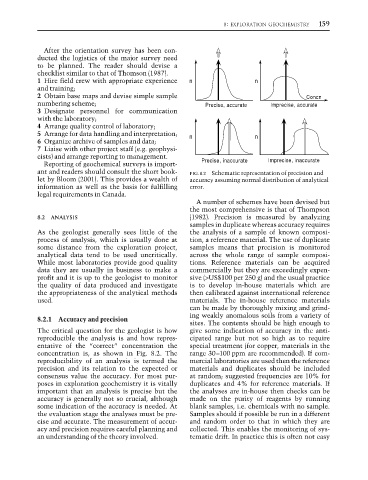
                 ant and readers should consult the short book-  FIG. 8.2 Schematic representation of precision and
                 let by Bloom (2001). This provides a wealth of  accuracy assuming normal distribution of analytical
                 information as well as the basis for fulfilling  error.
                 legal requirements in Canada.
                                                                A number of schemes have been devised but
                                                              the most comprehensive is that of Thompson
                 8.2  ANALYSIS                                (1982). Precision is measured by analyzing
                                                              samples in duplicate whereas accuracy requires
                 As the geologist generally sees little of the  the analysis of a sample of known composi-
                 process of analysis, which is usually done at  tion, a reference material. The use of duplicate
                 some distance from the exploration project,  samples means that precision is monitored
                 analytical data tend to be used uncritically.  across the whole range of sample composi-
                 While most laboratories provide good quality  tions. Reference materials can be acquired
                 data they are usually in business to make a  commercially but they are exceedingly expen-
                 profit and it is up to the geologist to monitor  sive (>US$100 per 250 g) and the usual practice
                 the quality of data produced and investigate  is to develop in-house materials which are
                 the appropriateness of the analytical methods  then calibrated against international reference
                 used.                                        materials. The in-house reference materials
                                                              can be made by thoroughly mixing and grind-
                                                              ing weakly anomalous soils from a variety of
                 8.2.1 Accuracy and precision
                                                              sites. The contents should be high enough to
                 The critical question for the geologist is how  give some indication of accuracy in the anti-
                 reproducible the analysis is and how repres-  cipated range but not so high as to require
                 entative of the “correct” concentration the  special treatment (for copper, materials in the
                 concentration is, as shown in Fig. 8.2. The  range 30–100 ppm are recommended). If com-
                 reproducibility of an analysis is termed the  mercial laboratories are used then the reference
                 precision and its relation to the expected or  materials and duplicates should be included
                 consensus value the accuracy. For most pur-  at random; suggested frequencies are 10% for
                 poses in exploration geochemistry it is vitally  duplicates and 4% for reference materials. If
                 important that an analysis is precise but the  the analyses are in-house then checks can be
                 accuracy is generally not so crucial, although  made on the purity of reagents by running
                 some indication of the accuracy is needed. At  blank samples, i.e. chemicals with no sample.
                 the evaluation stage the analyses must be pre-  Samples should if possible be run in a different
                 cise and accurate. The measurement of accur-  and random order to that in which they are
                 acy and precision requires careful planning and  collected. This enables the monitoring of sys-
                 an understanding of the theory involved.     tematic drift. In practice this is often not easy

