


Page 180 - Introduction to Mineral Exploration
P. 180
8: EXPLORATION GEOCHEMISTRY  163


                 association reflecting hydrothermal alteration
                 or even element depletion. Anomalies are            l
                 defined by statistically grouping data and       2.72  l              A:12.6%
                 comparing these with geology and sampling               l  l
                                                                           l
                 information. Normally this grouping will be                l l
                 undertaken by computer and a wide variety of    2.24         l l
                 statistical packages are available; for micro-  Log (ppm)    l l
                 computers, one of MINITAB, SYSTAT, and          1.76           l l
                 STATISTICA is recommended at a cost of                           l  l  l
                 $US200–500 each.                                        B:87.4%       l  l
                   The best means of statistically grouping data  1.28                     l   l
                 is graphical examination using histograms and          Cu                        l  l
                 box plots (Howarth 1984, Garrett 1989). This
                 is coupled with description using measures of   0.80  99  95  85  70  50  30  15  5  1
                 central tendency (mean or median) and of stat-                 Cumulative (%)
                 istical dispersion (usually standard deviation).
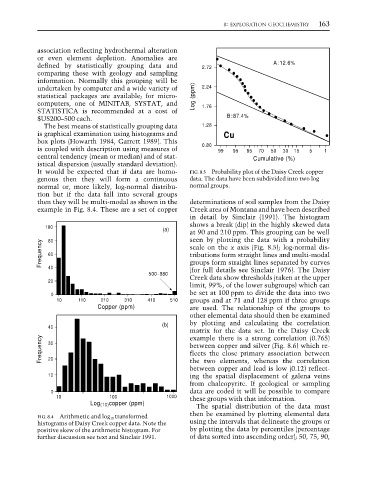
                 It would be expected that if data are homo-  FIG. 8.5 Probability plot of the Daisy Creek copper
                 genous then they will form a continuous      data. The data have been subdivided into two log
                 normal or, more likely, log-normal distribu-  normal groups.
                 tion but if the data fall into several groups
                 then they will be multi-modal as shown in the  determinations of soil samples from the Daisy
                 example in Fig. 8.4. These are a set of copper  Creek area of Montana and have been described
                                                              in detail by Sinclair (1991). The histogram
                                                              shows a break (dip) in the highly skewed data
                    100
                                                      (a)
                                                              at 90 and 210 ppm. This grouping can be well
                                                              seen by plotting the data with a probability
                     80
                   Frequency  60                              scale on the  x axis (Fig. 8.5); log-normal dis-
                                                              tributions form straight lines and multi-modal
                                                              groups form straight lines separated by curves
                     40
                                                  500 -980    (for full details see Sinclair 1976). The Daisy
                     20                                       Creek data show thresholds (taken at the upper
                                                              limit, 99%, of the lower subgroups) which can
                     0                                        be set at 100 ppm to divide the data into two
                       10    110    210    310    410   510   groups and at 71 and 128 ppm if three groups
                                   Copper (ppm)               are used. The relationship of the groups to
                                                              other elemental data should then be examined
                                                      (b)     by plotting and calculating the correlation
                     40
                                                              matrix for the data set. In the Daisy Creek
                                                              example there is a strong correlation (0.765)
                   Frequency  30                              between copper and silver (Fig. 8.6) which re-
                                                              flects the close primary association between
                     20
                                                              the two elements, whereas the correlation
                                                              between copper and lead is low (0.12) reflect-
                     10                                       ing the spatial displacement of galena veins
                                                              from chalcopyrite. If geological or sampling
                     0                                        data are coded it will be possible to compare
                       10              100             1000   these groups with that information.
                                 Log (10) copper (ppm)
                                                                The spatial distribution of the data must
                 FIG. 8.4  Arithmetic and log 10  transformed  then be examined by plotting elemental data
                 histograms of Daisy Creek copper data. Note the  using the intervals that delineate the groups or
                 positive skew of the arithmetic histogram. For  by plotting the data by percentiles (percentage
                 further discussion see text and Sinclair 1991.  of data sorted into ascending order); 50, 75, 90,

