


Page 183 - Introduction to Mineral Exploration
P. 183
166   C.J. MOON


                  Survey, is to sieve the samples in the field  massive sulfide mineralisation and the copper
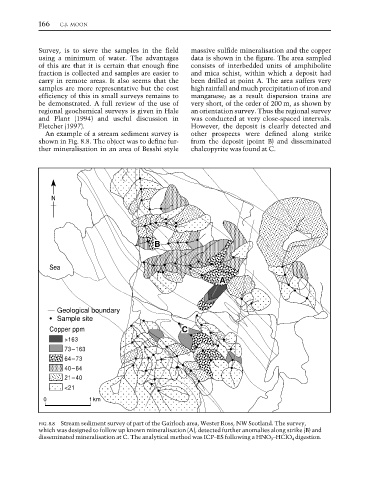
                  using a minimum of water. The advantages    data is shown in the figure. The area sampled
                  of this are that it is certain that enough fine  consists of interbedded units of amphibolite
                  fraction is collected and samples are easier to  and mica schist, within which a deposit had
                  carry in remote areas. It also seems that the  been drilled at point A. The area suffers very
                  samples are more representative but the cost  high rainfall and much precipitation of iron and
                  efficiency of this in small surveys remains to  manganese; as a result dispersion trains are
                  be demonstrated. A full review of the use of  very short, of the order of 200 m, as shown by
                  regional geochemical surveys is given in Hale  an orientation survey. Thus the regional survey
                  and Plant (1994) and useful discussion in   was conducted at very close-spaced intervals.
                  Fletcher (1997).                            However, the deposit is clearly detected and
                    An example of a stream sediment survey is  other prospects were defined along strike
                  shown in Fig. 8.8. The object was to define fur-  from the deposit (point B) and disseminated
                  ther mineralisation in an area of Besshi style  chalcopyrite was found at C.


                      N


                                                    B


                     Sea
                                                                       A


                       Geological boundary
                     •  Sample site
                     Copper ppm                             C
                         >163
                         73–163
                         64–73
                         40–64
                         21–40
                         <21
                   0             1km


                  FIG. 8.8 Stream sediment survey of part of the Gairloch area, Wester Ross, NW Scotland. The survey,
                  which was designed to follow up known mineralisation (A), detected further anomalies along strike (B) and
                  disseminated mineralisation at C. The analytical method was ICP–ES following a HNO 3 –HClO 4  digestion.

