


Page 182 - Introduction to Mineral Exploration
P. 182
8: EXPLORATION GEOCHEMISTRY  165


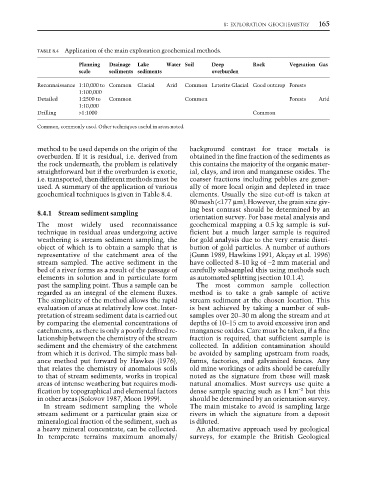
                 TABLE 8.4  Application of the main exploration geochemical methods.

                              Planning  Drainage  Lake  Water Soil  Deep        Rock       Vegetation Gas
                              scale   sediments sediments           overburden

                 Reconnaissance 1:10,000 to Common  Glacial  Arid  Common Laterite Glacial Good outcrop Forests
                              1:100,000
                 Detailed     1:2500 to  Common             Common                         Forests  Arid
                              1:10,000
                 Drilling     >1:1000                                           Common
                 Common, commonly used. Other techniques useful in areas noted.


                 method to be used depends on the origin of the  background contrast for trace metals is
                 overburden. If it is residual, i.e. derived from  obtained in the fine fraction of the sediments as
                 the rock underneath, the problem is relatively  this contains the majority of the organic mater-
                 straightforward but if the overburden is exotic,  ial, clays, and iron and manganese oxides. The
                 i.e. transported, then different methods must be  coarser fractions including pebbles are gener-
                 used. A summary of the application of various  ally of more local origin and depleted in trace
                 geochemical techniques is given in Table 8.4.  elements. Usually the size cut-off is taken at
                                                              80 mesh (<177 µm). However, the grain size giv-
                                                              ing best contrast should be determined by an
                 8.4.1 Stream sediment sampling
                                                              orientation survey. For base metal analysis and
                 The most widely used reconnaissance          geochemical mapping a 0.5 kg sample is suf-
                 technique in residual areas undergoing active  ficient but a much larger sample is required
                 weathering is stream sediment sampling, the  for gold analysis due to the very erratic distri-
                 object of which is to obtain a sample that is  bution of gold particles. A number of authors
                 representative of the catchment area of the  (Gunn 1989, Hawkins 1991, Akçay et al. 1996)
                 stream sampled. The active sediment in the   have collected 8–10 kg of −2 mm material and
                 bed of a river forms as a result of the passage of  carefully subsampled this using methods such
                 elements in solution and in particulate form  as automated splitting (section 10.1.4).
                 past the sampling point. Thus a sample can be  The most common sample collection
                 regarded as an integral of the element fluxes.  method is to take a grab sample of active
                 The simplicity of the method allows the rapid  stream sediment at the chosen location. This
                 evaluation of areas at relatively low cost. Inter-  is best achieved by taking a number of sub-
                 pretation of stream sediment data is carried out  samples over 20–30 m along the stream and at
                 by comparing the elemental concentrations of  depths of 10–15 cm to avoid excessive iron and
                 catchments, as there is only a poorly defined re-  manganese oxides. Care must be taken, if a fine
                 lationship between the chemistry of the stream  fraction is required, that sufficient sample is
                 sediment and the chemistry of the catchment  collected. In addition contamination should
                 from which it is derived. The simple mass bal-  be avoided by sampling upstream from roads,
                 ance method put forward by Hawkes (1976),    farms, factories, and galvanized fences. Any
                 that relates the chemistry of anomalous soils  old mine workings or adits should be carefully
                 to that of stream sediments, works in tropical  noted as the signature from these will mask
                 areas of intense weathering but requires modi-  natural anomalies. Most surveys use quite a
                                                                                              −2
                 fication by topographical and elemental factors  dense sample spacing such as 1 km  but this
                 in other areas (Solovov 1987, Moon 1999).    should be determined by an orientation survey.
                   In stream sediment sampling the whole      The main mistake to avoid is sampling large
                 stream sediment or a particular grain size or  rivers in which the signature from a deposit
                 mineralogical fraction of the sediment, such as  is diluted.
                 a heavy mineral concentrate, can be collected.  An alternative approach used by geological
                 In temperate terrains maximum anomaly/       surveys, for example the British Geological

