


Page 181 - Introduction to Mineral Exploration
P. 181
164   C.J. MOON


                  (a)  1400
                                                                    +  +  +  +  +  +  +  +  +
                                                                    +  +  +  +  +  +  +  +  +
                    1200
                                                                    +  +  +  +  +  +  +  +  +
                                                                    + +  +  + +  + + +  + +  + +  + +  + +  + +  +  N
                   Lead (ppm) 1000                             +  + + +  + + + + + + + + + + + + + + + + + + + +  + + + + + + + + +  + + + + + + + + + + + + + + + +  + +
                                                               +
                                                                      +
                     800
                                                                      +
                                                                         +
                                                                      +
                                                                         +
                     600
                                                                      +
                                                                         +
                     400                                       +    + + + + + + + + + + + + + +  + + + + + +  + + + +  + +  + +  +
                                                               +    + + + + + + + +  + + +  + + + + +  +  +
                     200                                            +  + + + + + +  +  +  +  +  +
                                                                                                  Cu
                                                               +    +  + + + + + +  +  +  +  +  +  +
                       0
                                                                    +  + + + + +  +  +  +  +  +   Pb
                  (b)  2                                       +    +  +  +  +  +  +  +  +  +  +  Ag
                                                               +  +  +  +  +  +  +  +  +
                                                               +  +  +  +  +  +  +  +  +
                                                                                          0         50 m
                     1.5                                       +  +  +  +  +  +  +  +  +
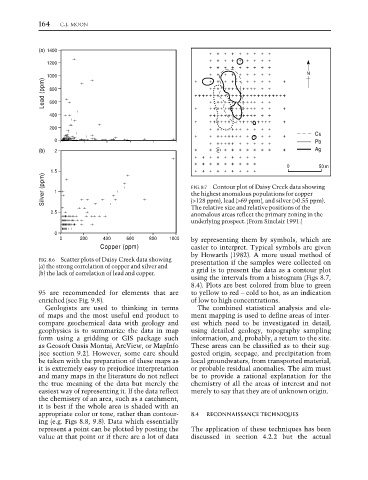
                   Silver (ppm)  1                            FIG. 8.7  Contour plot of Daisy Creek data showing
                                                              the highest anomalous populations for copper
                                                              (>128 ppm), lead (>69 ppm), and silver (>0.55 ppm).
                                                              The relative size and relative positions of the
                     0.5
                                                              anomalous areas reflect the primary zoning in the
                                                              underlying prospect. (From Sinclair 1991.)
                       0
                        0     200    400   600    800   1000  by representing them by symbols, which are
                                    Copper (ppm)              easier to interpret. Typical symbols are given
                                                              by Howarth (1982). A more usual method of
                  FIG. 8.6  Scatter plots of Daisy Creek data showing  presentation if the samples were collected on
                  (a) the strong correlation of copper and silver and  a grid is to present the data as a contour plot
                  (b) the lack of correlation of lead and copper.
                                                              using the intervals from a histogram (Figs 8.7,
                                                              8.4). Plots are best colored from blue to green
                  95 are recommended for elements that are    to yellow to red – cold to hot, as an indication
                  enriched (see Fig. 9.8).                    of low to high concentrations.
                    Geologists are used to thinking in terms    The combined statistical analysis and ele-
                  of maps and the most useful end product to  ment mapping is used to define areas of inter-
                  compare geochemical data with geology and   est which need to be investigated in detail,
                  geophysics is to summarize the data in map  using detailed geology, topography sampling
                  form using a gridding or GIS package such   information, and, probably, a return to the site.
                  as Geosoft Oasis Montaj, ArcView, or MapInfo  These areas can be classified as to their sug-
                  (see section 9.2). However, some care should  gested origin, seepage, and precipitation from
                  be taken with the preparation of these maps as  local groundwaters, from transported material,
                  it is extremely easy to prejudice interpretation  or probable residual anomalies. The aim must
                  and many maps in the literature do not reflect  be to provide a rational explanation for the
                  the true meaning of the data but merely the  chemistry of all the areas of interest and not
                  easiest way of representing it. If the data reflect  merely to say that they are of unknown origin.
                  the chemistry of an area, such as a catchment,
                  it is best if the whole area is shaded with an
                  appropriate color or tone, rather than contour-  8.4  RECONNAISSANCE TECHNIQUES
                  ing (e.g. Figs 8.8, 9.8). Data which essentially
                  represent a point can be plotted by posting the  The application of these techniques has been
                  value at that point or if there are a lot of data  discussed in section 4.2.2 but the actual

