


Page 186 - Introduction to Mineral Exploration
P. 186
8: EXPLORATION GEOCHEMISTRY  169


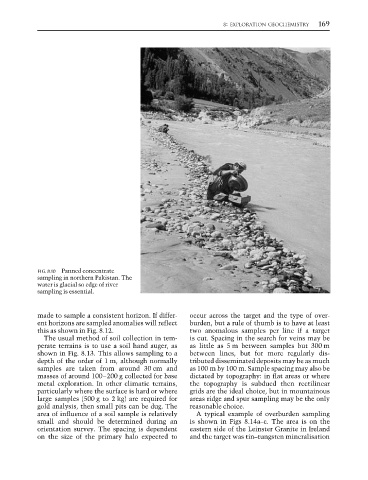
                 FIG. 8.10  Panned concentrate
                 sampling in northern Pakistan. The
                 water is glacial so edge of river
                 sampling is essential.


                 made to sample a consistent horizon. If differ-  occur across the target and the type of over-
                 ent horizons are sampled anomalies will reflect  burden, but a rule of thumb is to have at least
                 this as shown in Fig. 8.12.                  two anomalous samples per line if a target
                   The usual method of soil collection in tem-  is cut. Spacing in the search for veins may be
                 perate terrains is to use a soil hand auger, as  as little as 5 m between samples but 300 m
                 shown in Fig. 8.13. This allows sampling to a  between lines, but for more regularly dis-
                 depth of the order of 1 m, although normally  tributed disseminated deposits may be as much
                 samples are taken from around 30 cm and      as 100 m by 100 m. Sample spacing may also be
                 masses of around 100–200 g collected for base  dictated by topography: in flat areas or where
                 metal exploration. In other climatic terrains,  the topography is subdued then rectilinear
                 particularly where the surface is hard or where  grids are the ideal choice, but in mountainous
                 large samples (500 g to 2 kg) are required for  areas ridge and spur sampling may be the only
                 gold analysis, then small pits can be dug. The  reasonable choice.
                 area of influence of a soil sample is relatively  A typical example of overburden sampling
                 small and should be determined during an     is shown in Figs 8.14a–c. The area is on the
                 orientation survey. The spacing is dependent  eastern side of the Leinster Granite in Ireland
                 on the size of the primary halo expected to  and the target was tin–tungsten mineralisation

