


Page 189 - Introduction to Mineral Exploration
P. 189
172   C.J. MOON


                  (b)
                               0
                     60–70
                     50–60     1                                                         Copper ppm
                     40–50    Depth (m)  2
                     30–40
                     20–30     3
                     10–20     4
                      0–10


                               0
                     300–350
                     250–300   1                                                         Arsenic ppm
                     200–250   2
                     150–200  Depth (m)
                     100–150   3
                      50–100   4
                       0–50


                               0
                     45–55
                     35–45     1                                                        Tungsten ppm
                     25–35    Depth (m)  2
                     15–25
                     10–15     3
                      5–10     4
                      0–5
                                300           400          500           600           700           800
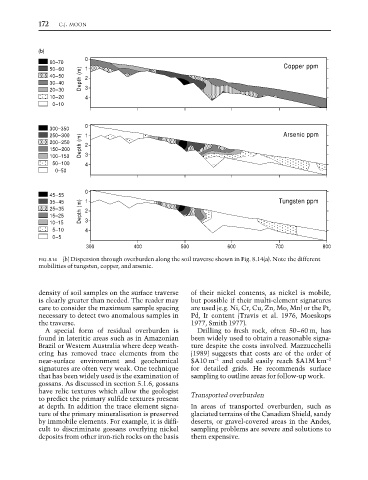
                  FIG. 8.14 (b) Dispersion through overburden along the soil traverse shown in Fig. 8.14(a). Note the different
                  mobilities of tungsten, copper, and arsenic.


                  density of soil samples on the surface traverse  of their nickel contents, as nickel is mobile,
                  is clearly greater than needed. The reader may  but possible if their multi-element signatures
                  care to consider the maximum sample spacing  are used (e.g. Ni, Cr, Cu, Zn, Mo, Mn) or the Pt,
                  necessary to detect two anomalous samples in  Pd, Ir content (Travis et al. 1976, Moeskops
                  the traverse.                               1977, Smith 1977).
                    A special form of residual overburden is    Drilling to fresh rock, often 50–60 m, has
                  found in lateritic areas such as in Amazonian  been widely used to obtain a reasonable signa-
                  Brazil or Western Australia where deep weath-  ture despite the costs involved. Mazzucchelli
                  ering has removed trace elements from the   (1989) suggests that costs are of the order of
                                                                     −1
                  near-surface environment and geochemical    $A10 m  and could easily reach $A1M km  −2
                  signatures are often very weak. One technique  for detailed grids. He recommends surface
                  that has been widely used is the examination of  sampling to outline areas for follow-up work.
                  gossans. As discussed in section 5.1.6, gossans
                  have relic textures which allow the geologist
                  to predict the primary sulfide textures present  Transported overburden
                  at depth. In addition the trace element signa-  In areas of transported overburden, such as
                  ture of the primary mineralisation is preserved  glaciated terrains of the Canadian Shield, sandy
                  by immobile elements. For example, it is diffi-  deserts, or gravel-covered areas in the Andes,
                  cult to discriminate gossans overlying nickel  sampling problems are severe and solutions to
                  deposits from other iron-rich rocks on the basis  them expensive.

