


Page 192 - Introduction to Mineral Exploration
P. 192
8: EXPLORATION GEOCHEMISTRY  175


                                                              have been used of which mercury has been the
                  24° 30'S                                    most successful. Mercury is the only metallic
                                                   WIND
                                      DK                      element which forms a vapor at room tempera-
                      N               2                       ture and it is widely present in sulfide deposits,
                                              DK              particularly volcanic-associated base metal
                                              7               deposits. The gas radon is generated during the
                                                              decay of uranium and has been widely used
                                                              with some success. More recently the enrich-
                                       DK      DK             ment of carbon dioxide and depletion of oxygen
                                       6               DK     caused by weathering of sulfide deposits has
                                 DK            5 DK    9      been tested, particularly in the western USA
                                 4              3 DK
                                                  1           (Lovell & Reid 1989).
                    Ilmenite counts                             In general results have been disappointing
                       > 5                                    because of the large variations in gas concen-
                       > 10                                   tration (partial pressure) caused by changes in
                       > 20             0            10 km
                       > 40                                   environmental conditions, particularly changes
                       DK2 Kimberlite                         in barometric pressure and rainfall. The more
                                          24° 45'E
                                                              successful radon and mercury surveys have
                                                              sought to overcome these variations by inte-
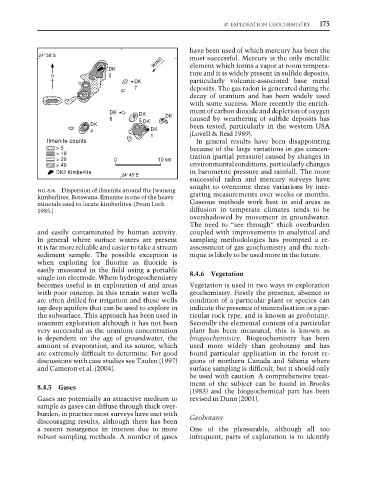
                 FIG. 8.16  Dispersion of ilmenite around the Jwaneng  grating measurements over weeks or months.
                 kimberlites, Botswana. Ilmenite is one of the heavy
                 minerals used to locate kimberlites. (From Lock  Gaseous methods work best in arid areas as
                 1985.)                                       diffusion in temperate climates tends to be
                                                              overshadowed by movement in groundwater.
                                                              The need to “see through” thick overburden
                 and easily contaminated by human activity.   coupled with improvements in analytical and
                 In general where surface waters are present  sampling methodologies has prompted a re-
                 it is far more reliable and easier to take a stream  assessment of gas geochemistry and the tech-
                 sediment sample. The possible exception is   nique is likely to be used more in the future.
                 when exploring for fluorite as fluoride is
                 easily measured in the field using a portable
                 single ion electrode. Where hydrogeochemistry  8.4.6 Vegetation
                 becomes useful is in exploration of arid areas  Vegetation is used in two ways in exploration
                 with poor outcrop. In this terrain water wells  geochemistry. Firstly the presence, absence or
                 are often drilled for irrigation and these wells  condition of a particular plant or species can
                 tap deep aquifers that can be used to explore in  indicate the presence of mineralisation or a par-
                 the subsurface. This approach has been used in  ticular rock type, and is known as geobotany.
                 uranium exploration although it has not been  Secondly the elemental content of a particular
                 very successful as the uranium concentration  plant has been measured, this is known as
                 is dependent on the age of groundwater, the  biogeochemistry. Biogeochemistry has been
                 amount of evaporation, and its source, which  used more widely than geobotany and has
                 are extremely difficult to determine. For good  found particular application in the forest re-
                 discussions with case studies see Taufen (1997)  gions of northern Canada and Siberia where
                 and Cameron et al. (2004).                   surface sampling is difficult, but it should only
                                                              be used with caution. A comprehensive treat-
                                                              ment of the subject can be found in Brooks
                 8.4.5 Gases
                                                              (1983) and the biogeochemical part has been
                 Gases are potentially an attractive medium to  revised in Dunn (2001).
                 sample as gases can diffuse through thick over-
                 burden; in practice most surveys have met with
                 discouraging results, although there has been  Geobotany
                 a recent resurgence in interest due to more  One of the pleasurable, although all too
                 robust sampling methods. A number of gases   infrequent, parts of exploration is to identify

