


Page 190 - Introduction to Mineral Exploration
P. 190
8: EXPLORATION GEOCHEMISTRY  173


                 (c)                                          Lightweight drills are cheaper and easier to
                    400                                       operate but results are often ambiguous, as it is
                                                              not easy to differentiate the base of overburden
                   As ppm 300                                 from striking a boulder. The use of heavy
                                                              equipment in most glaciated areas is restricted
                    200
                    100                                       to the winter when the ground is frozen. The
                                                              difficulties of finding the source of glacial dis-
                                                              persion trains for small targets at Lac de Gras,
                     0
                                                              Canada, are discussed in section 17.2.
                   1.25
                                                                In sandy deserts water is scarce, most move-
                   1.00                                       ment is mechanical, and most fine material
                   Bi ppm  0.75                               is windblown. Thus the −80 mesh fraction of
                                                              overburden is enriched in windblown material
                   0.50
                                                              and is of little use. In such areas either a coarse
                   0.25
                                                              fraction (e.g. 2–6 mm), reflecting locally derived
                   0.00                                       material, or the clay fraction reflecting ele-
                                                              ments moved in solution is used (Carver et al.
                    50                                        1987). One of the most successful uses of
                   Cu ppm  25                                 this approach has been in the exploration for
                                                              kimberlites in central Botswana. Figure 8.16
                                                              shows the result of a regional sampling pro-
                     0                                        gram which discovered kimberlite pipes in
                      0  100  200  300  400  500  600  700  800  900  1000 1100  the Jwaneng area. Samples were taken on a
                                    Distance (m)
                                                              0.5 km grid, heavy minerals separated from
                                                              the  +0.42 mm fraction and the number of
                                                              kimberlite indicator minerals, such as picro-
                                                              ilmenite, counted. The anomalies shown are
                                                              displaced from the suboutcrop probably due
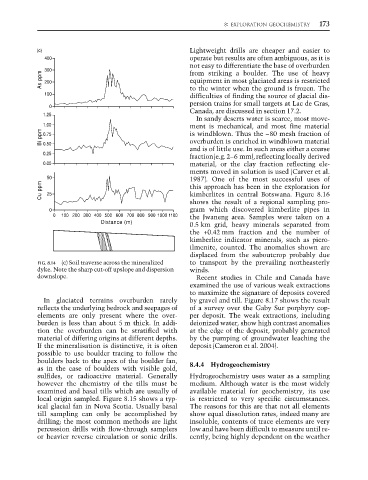
                 FIG. 8.14 (c) Soil traverse across the mineralized  to transport by the prevailing northeasterly
                 dyke. Note the sharp cut-off upslope and dispersion  winds.
                 downslope.                                     Recent studies in Chile and Canada have
                                                              examined the use of various weak extractions
                                                              to maximize the signature of deposits covered
                   In glaciated terrains overburden rarely    by gravel and till. Figure 8.17 shows the result
                 reflects the underlying bedrock and seepages of  of a survey over the Gaby Sur porphyry cop-
                 elements are only present where the over-    per deposit. The weak extractions, including
                 burden is less than about 5 m thick. In addi-  deionized water, show high contrast anomalies
                 tion the overburden can be stratified with    at the edge of the deposit, probably generated
                 material of differing origins at different depths.  by the pumping of groundwater leaching the
                 If the mineralisation is distinctive, it is often  deposit (Cameron et al. 2004).
                 possible to use boulder tracing to follow the
                 boulders back to the apex of the boulder fan,
                 as in the case of boulders with visible gold,  8.4.4 Hydrogeochemistry
                 sulfides, or radioactive material. Generally  Hydrogeochemistry uses water as a sampling
                 however the chemistry of the tills must be   medium. Although water is the most widely
                 examined and basal tills which are usually of  available material for geochemistry, its use
                 local origin sampled. Figure 8.15 shows a typ-  is restricted to very specific circumstances.
                 ical glacial fan in Nova Scotia. Usually basal  The reasons for this are that not all elements
                 till sampling can only be accomplished by    show equal dissolution rates, indeed many are
                 drilling; the most common methods are light  insoluble, contents of trace elements are very
                 percussion drills with flow-through samplers  low and have been difficult to measure until re-
                 or heavier reverse circulation or sonic drills.  cently, being highly dependent on the weather

