


Page 366 - Sami Franssila Introduction to Microfabrication
P. 366
Cleanrooms 345


           taken into an airlock where the inner packing material  35.2 CLEANROOM SUBSYSTEMS
           (which was wrapped in the cleanroom of wafer, target
                                                       35.2.1 Construction
           or tool manufacturer) is removed. Depending on the
           item, manual cleaning with isopropyl alcohol may
                                                       Cleanroom envelopes – walls, floor, ceiling, and so
           be undertaken.
                                                       on – need to be made of materials compatible with the
             As discussed in Chapter 34, cleanrooms need not
                                                       overall objective of environmental control. The walls
           be large halls or rooms; mini-environments are locally
                                                       must not outgas, they must be easy to clean and they
           clean areas around critical process tools. If wafers are
                                                       must be easily removable for equipment installation.
           enclosed in portable mini-environments, they will never
                                                       They must also be tight because cleanliness is partly
           experience cleanroom air, which can then be orders of
                                                       ensured by slight overpressure, which prevents outside
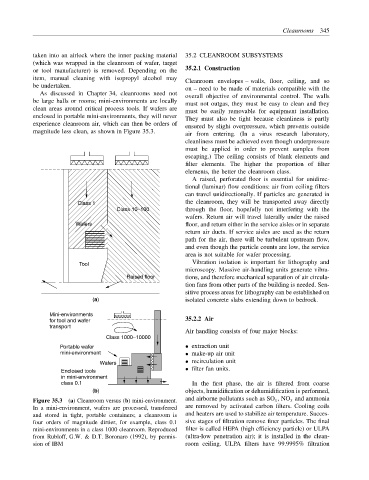
           magnitude less clean, as shown in Figure 35.3.
                                                       air from entering. (In a virus research laboratory,
                                                       cleanliness must be achieved even though underpressure
                                                       must be applied in order to prevent samples from
                                                       escaping.) The ceiling consists of blank elements and
                                                       filter elements. The higher the proportion of filter
                                                       elements, the better the cleanroom class.
                                                         A raised, perforated floor is essential for unidirec-
                                                       tional (laminar) flow conditions: air from ceiling filters
                                                       can travel unidirectionally. If particles are generated in
                        Class 1                        the cleanroom, they will be transported away directly
                                   Class 10−100        through the floor, hopefully not interfering with the
                                                       wafers. Return air will travel laterally under the raised
                       Wafers                          floor, and return either in the service aisles or in separate
                                                       return air ducts. If service aisles are used as the return
                                                       path for the air, there will be turbulent upstream flow,
                                                       and even though the particle counts are low, the service
                                                       area is not suitable for wafer processing.
                        Tool                             Vibration isolation is important for lithography and
                                                       microscopy. Massive air-handling units generate vibra-
                                      Raised floor     tions, and therefore mechanical separation of air circula-
                                                       tion fans from other parts of the building is needed. Sen-
                                                       sitive process areas for lithography can be established on
                            (a)                        isolated concrete slabs extending down to bedrock.
               Mini-environments
               for tool and wafer                      35.2.2 Air
               transport
                                                       Air handling consists of four major blocks:
                                Class 1000−10000
                  Portable wafer                       • extraction unit
                  mini-environment                     • make-up air unit
                              Wafers                   • recirculation unit
                   Enclosed tools                      • filter fan units.
                   in mini-environment
                   class 0.1                             In the first phase, the air is filtered from coarse
                            (b)                        objects, humidification or dehumidification is performed,
                                                       and airborne pollutants such as SO x , NO x and ammonia
           Figure 35.3 (a) Cleanroom versus (b) mini-environment.
           In a mini-environment, wafers are processed, transferred  are removed by activated carbon filters. Cooling coils
           and stored in tight, portable containers; a cleanroom is  and heaters are used to stabilize air temperature. Succes-
           four orders of magnitude dirtier, for example, class 0.1  sive stages of filtration remove finer particles. The final
           mini-environments in a class 1000 cleanroom. Reproduced  filter is called HEPA (high efficiency particle) or ULPA
           from Rubloff, G.W. & D.T. Boronaro (1992), by permis-  (ultra-low penetration air); it is installed in the clean-
           sion of IBM                                 room ceiling. ULPA filters have 99.9995% filtration

