


Page 222 - Materials Chemistry, Second Edition
P. 222
208   LIFE CYCLE ASSESSMENT HANDBOOK

              8.5.3  LCA and    ExLCA Results    and  Discussion
              Environmental  impacts  for  the  Cu-Cl  thermochemical  hydrogen  production
              process, based on one MJ exergy  of hydrogen production, are presented  in this
              section. The following  CML 2001  impact categories are  examined:


                   •  acidification  potential  (AP)
                   •  eutrophication  potential  (EP)
                   •  global warming potential  (GWP)
                   •  ozone depletion potential  (ODP)


                 Environmental  effects  for  nuclear-based  hydrogen  production  using  the
              five-step  Cu-Cl  thermochemical  cycle  in  terms  of  the  four  above  impact  cat-
              egories  are  calculated  by  altering  the  lifetime  of  the  overall  system  from  10
              years to  100 years for two plant capacities  (125,000 and  62,500 kg H 2 /day).
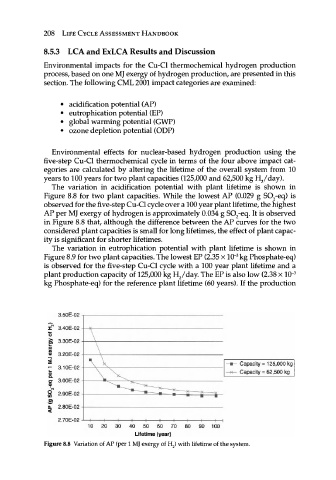
                 The  variation  in  acidification  potential  with  plant  lifetime  is  shown  in
              Figure  8.8  for  two  plant  capacities.  While  the  lowest  AP  (0.029  g  S0 2-eq)  is
              observed for the five-step Cu-Cl cycle over a 100 year plant lifetime, the highest
              AP per  MJ exergy  of hydrogen  is approximately  0.034 g S0 2-eq.  It is  observed
              in Figure  8.8 that, although  the  difference  between  the AP curves  for  the  two
              considered plant capacities is small for long lifetimes, the effect  of plant  capac-
              ity is significant  for shorter  lifetimes.
                 The  variation  in  eutrophication  potential  with  plant  lifetime  is  shown  in
                                                                         3
              Figure 8.9 for two plant capacities. The lowest EP (2.35 x 10~ kg Phosphate-eq)
              is observed  for  the  five-step  Cu-Cl  cycle with  a  100 year  plant  lifetime  and  a
              plant production  capacity  of  125,000 kg  H 2 /day  The EP is also low  (2.38 x 10" 3
              kg Phosphate-eq)  for  the  reference  plant  lifetime  (60 years).  If the  production


                   3.50E-I

               2*  3.40E
                o           \
                gj  3.30E
                0)            \
                S  3.20E
               Έ            \ V                                      -m-  Capacity = 125,000 kg
               *-  3.10E
                a>            w                                      —κ-  Capacity = 62,500 kg
                σ  3.00Ε
                Q)
                I
               gf  2.90E                               —Hi—  ^■i  I
               3
               üT  2.80E
               <          - I — i  1  1  1   \—  1   1   1    1   1  1
                   2.70E-I   10  20  30  40  50  60  70  80  90  100
                                          Lifetime  (year)
              Figure  8.8  Variation  of AP (per  1 MJ exergy  of H 2) with  lifetime  of the  system.

