


Page 220 - Materials Chemistry, Second Edition
P. 220
206   LIFE CYCLE ASSESSMENT HANDBOOK

               Nuclear  Based Hydrogen  Production
               GaBi 4 process plan:Reference quantities


                                        Construction of Nuclear  ISl    Consruction of Hydrogen  ISl
                                        Plant                           Plant


                Fuel Process   E|       Utilization of Nuclear Plant Ε3Γ   " *  Utilization of Hydrogen  XES)
                                      •4                               L  Plant


                                        Heavy Water ProductiorXEl

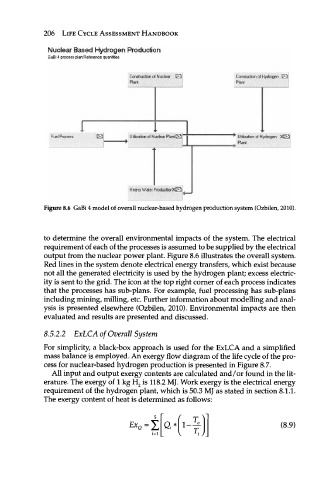
              Figure  8.6  GaBi 4 model  of overall nuclear-based  hydrogen  production  system  (Ozbilen, 2010).


              to determine  the overall  environmental  impacts  of the  system. The  electrical
              requirement  of each of the processes is assumed to be supplied by the electrical
              output  from  the nuclear power plant. Figure 8.6 illustrates the overall system.
              Red lines in the system denote electrical energy transfers, which exist because
              not all the generated  electricity is used by the hydrogen plant; excess electric-
              ity is sent to the grid. The icon at the top right corner  of each process indicates
              that  the processes has sub-plans. For example,  fuel  processing  has  sub-plans
              including mining, milling, etc. Further information  about modelling and anal-
              ysis  is presented  elsewhere  (Ozbilen,  2010). Environmental  impacts  are  then
              evaluated and results are presented and  discussed.


              8.5.2.2  ExLCA   of Overall  System
              For  simplicity,  a black-box  approach  is used  for  the  ExLCA and  a  simplified
              mass balance is employed. An exergy flow diagram   of the life cycle of the pro-
              cess for nuclear-based hydrogen production is presented  in Figure 8.7.
                 All input and output exergy contents are calculated and/or  found  in the lit-
              erature. The exergy  of 1  kg H 2 is 118.2 MJ. Work exergy is the electrical energy
              requirement  of the hydrogen plant, which is 50.3 MJ as stated in section 8.1.1.
              The exergy content  of heat is determined  as follows:


                                                           T
                                        ΕΧ                                           (8.9)
                                          Ω=Σ     Qi*
                                               2=1          l <  /

