


Page 221 - Materials Chemistry, Second Edition
P. 221
EXERGY ANALYSIS AND ITS CONNECTION TO LIFE CYCLE ASSESSMENT         207

                            Fuel                        Electr. to grid  HJO
                          Ex = 46.6 MJ                  Ex = 252 MJ  m =19 kg
                                         Electr.
                                        Ex = 0.7 MJ
                                        U (enriched)      T_J Heat
                        Fuel (uranium) processing  m = 0.00404 kg   Nuclear plant   Ex = 76.5 MJ   Hydrogen plant
                 U (ore)    TV = 26.7 %   Ex = 1060MJ   Ti = 36.4 %   η β =93.2%   ► H 2 m = 1 kg
              m = 0.00729 kg!   EX^ ^ 2916.3 MJ   EX*  = 673.8 MJ   Electr.       Ex = 118.2MJ
               Ex = 3929 MJ                                Ex = 50.3 MJ
                                                             Electr.
                                                    D,0    Ex = 6.7 MJ
                                                 Heavy water                     ► 0 2 m = 8 kg
                                                 production
                                                   H'O
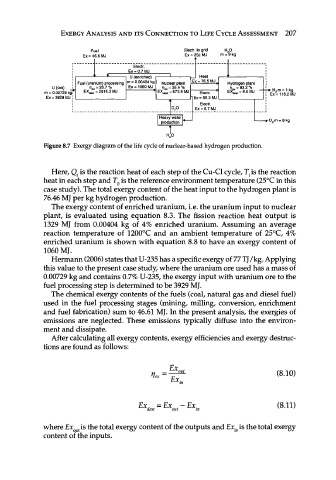
              Figure 8.7 Exergy diagram of the life cycle of nuclear-based hydrogen production.


                Here, Q. is the reaction heat of each step of the Cu-Cl cycle, T. is the reaction
              heat in each step and T 0 is the reference environment temperature (25°C in this
              case study). The total exergy content of the heat input to the hydrogen plant is
              76.46 MJ per kg hydrogen production.
                The exergy content of enriched uranium, i.e. the uranium input to nuclear
              plant, is evaluated using equation 8.3. The fission reaction heat output is
              1329 MJ from 0.00404 kg of 4% enriched uranium. Assuming an average
              reaction temperature of 1200°C and an ambient temperature of 25°C, 4%
              enriched uranium is shown with equation 8.8 to have an exergy content of
              1060 MJ.
                Hermann (2006) states that U-235 has a specific exergy of 77 TJ/kg. Applying
              this value to the present case study, where the uranium ore used has a mass of
              0.00729 kg and contains 0.7% U-235, the exergy input with uranium ore to the
              fuel processing step is determined to be 3929 MJ.
                The chemical exergy contents of the fuels (coal, natural gas and diesel fuel)
              used in the fuel processing stages (mining, milling, conversion, enrichment
              and fuel fabrication) sum to 46.61 MJ. In the present analysis, the exergies of
              emissions are neglected. These emissions typically diffuse into the environ-
              ment and dissipate.
                After calculating all exergy contents, exergy efficiencies and exergy destruc-
              tions are found as follows:


                                                    Ex
                                                  _ j^±out_
                                              Vex =                                 (8.10)
                                                    Ex-

                                           Ex, =Ex      -Ex.                        (8.11)
                                             dest    out    v
              where E* outis the total exergy content of the outputs and E* inis the total exergy
              content of the inputs.

