


Page 255 - Materials Chemistry, Second Edition
P. 255
A CASE STUDY OF THE PRACTICE OF SUSTAINABLE SUPPLY       243

                                   llllilll
                                              6 2
                                                                         6 4
                                   6 3
                                                   6 3
                                         58
                                                                   60
                                                              5 6
                                   4.2  3.3   3.2  4.9   5.7  4.6   4.5  4.4
                                / / 7 7 7 7 7 7


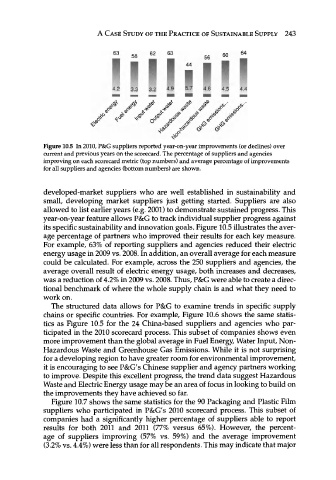
              Figure 10.5 In 2010, P&G suppliers reported year-on-year improvements (or declines) over
              current and previous years on the scorecard. The percentage of suppliers and agencies
              improving on each scorecard metric (top numbers) and average percentage of improvements
              for all suppliers and agencies (bottom numbers) are shown.


              developed-market suppliers who are well established in sustainability and
              small, developing market suppliers just getting started. Suppliers are also
              allowed to list earlier years (e.g. 2001) to demonstrate sustained progress. This
              year-on-year feature allows P&G to track individual supplier progress against
              its specific sustainability and innovation goals. Figure 10.5 illustrates the aver-
              age percentage of partners who improved their results for each key measure.
              For example, 63% of reporting suppliers and agencies reduced their electric
              energy usage in 2009 vs. 2008. In addition, an overall average for each measure
              could be calculated. For example, across the 250 suppliers and agencies, the
              average overall result of electric energy usage, both increases and decreases,
              was a reduction of 4.2% in 2009 vs. 2008. Thus, P&G were able to create a direc-
              tional benchmark of where the whole supply chain is and what they need to
              work on.
                The structured data allows for P&G to examine trends in specific supply
              chains or specific countries. For example, Figure 10.6 shows the same statis-
              tics as Figure 10.5 for the 24 China-based suppliers and agencies who par-
              ticipated in the 2010 scorecard process. This subset of companies shows even
              more improvement than the global average in Fuel Energy, Water Input, Non-
              Hazardous Waste and Greenhouse Gas Emissions. While it is not surprising
              for a developing region to have greater room for environmental improvement,
              it is encouraging to see P&G's Chinese supplier and agency partners working
              to improve. Despite this excellent progress, the trend data suggest Hazardous
              Waste and Electric Energy usage may be an area of focus in looking to build on
              the improvements they have achieved so far.
                Figure 10.7 shows the same statistics for the 90 Packaging and Plastic Film
              suppliers who participated in P&G's 2010 scorecard process. This subset of
              companies had a significantly higher percentage of suppliers able to report
              results for both 2011 and 2011 (77% versus 65%). However, the percent-
              age of suppliers improving (57% vs. 59%) and the average improvement
              (3.2% vs. 4.4%) were less than for all respondents. This may indicate that major

