


Page 254 - Materials Chemistry, Second Edition
P. 254
242   LIFE CYCLE ASSESSMENT   HANDBOOK
                                           29
                                                              Capital
                                                              Chemicals
                                                            ■  Durables/devices
                                                            ■  External manufacturing
                                                            ■  Global brand building
                                                              Global business services
                                                            ■  Logistics
                                                              Nat. comm. & ingredients
                                                              Packaging & hygiene


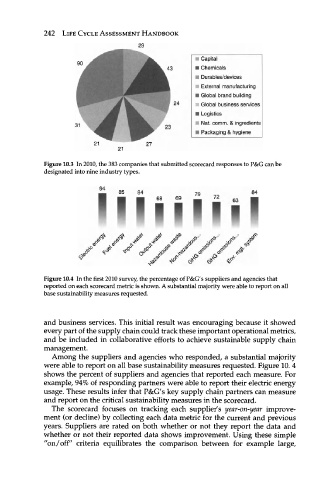
              Figure 10.3  In 2010, the 383 companies that submitted scorecard responses to P&G can be
              designated into nine industry types.
                              Hliiiiil
                               94
                               _
                                                                            84
                                     85
                                          84
                                                           7 9


                              jf*   ^     .**   .*?  ^     <§>'  &'   <&''  *&
                          f           ^     .«sr      f                 &
                         f                      no         >5>   >S>  x V
                                              *     *     &    &    <P
              Figure 10.4  In the first 2010 survey, the percentage of P&G's suppliers and agencies that
              reported on each scorecard metric is shown. A substantial majority were able to report on all
              base sustainability measures requested.


              and  business  services. This  initial  result was encouraging  because  it  showed
              every part of the supply chain could track these important operational metrics,
              and  be included  in  collaborative  efforts  to achieve  sustainable  supply  chain
              management.
                 Among   the suppliers  and agencies who responded,  a substantial  majority
              were able to report on all base sustainability measures requested. Figure  10. 4
              shows  the percent  of suppliers and agencies  that  reported  each  measure. For
              example, 94% of responding partners were   able to report  their  electric  energy
              usage. These results  infer  that  P&G's key supply  chain  partners  can measure
              and report on the critical sustainability measures in the scorecard.
                 The  scorecard  focuses  on  tracking  each  supplier's  year-on-year  improve-
              ment  (or decline) by collecting  each data  metric  for the current  and  previous
              years.  Suppliers  are rated  on both  whether  or not they  report  the data  and
              whether  or not their  reported  data  shows  improvement.  Using  these  simple
              "on/off   criteria  equilibrates  the  comparison  between  for  example  large,

