


Page 185 - Low Temperature Energy Systems with Applications of Renewable Energy
P. 185
172                 Low-Temperature Energy Systems with Applications of Renewable Energy


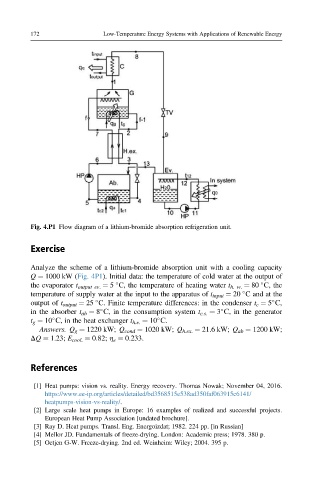
         Fig. 4.P1 Flow diagram of a lithium-bromide absorption refrigeration unit.

         Exercise


         Analyze the scheme of a lithium-bromide absorption unit with a cooling capacity
         Q ¼ 1000 kW (Fig. 4P1). Initial data: the temperature of cold water at the output of


         the evaporator t output ev. ¼ 5 C, the temperature of heating water t h. w. ¼ 80 C, the

         temperature of supply water at the input to the apparatus of t input ¼ 20 C and at the


         output of t output ¼ 25 C. Finite temperature differences: in the condenser t c ¼ 5 S,
         in the absorber t ab ¼ 8 S, in the consumption system t c.s. ¼ 3 S, in the generator


         t g ¼ 10 S, in the heat exchanger t h.e. ¼ 10 S.

            Answers. Q g ¼ 1220 kW; Q cond ¼ 1020 kW; Q h.ex. ¼ 21.6 kW; Q ab ¼ 1200 kW;
         DQ ¼ 1.23; E cool. ¼ 0.82; h e ¼ 0.233.
         References
          [1] Heat pumps: vision vs. reality. Energy recovery. Thomas Nowak; November 04, 2016.
             https://www.ee-ip.org/articles/detailed/bd3568515e538ad350faf063915c6141/
             heatpumps-vision-vs-reality/.
          [2] Large scale heat pumps in Europe: 16 examples of realized and successful projects.
             European Heat Pump Association [undated brochure].
          [3] Ray D. Heat pumps. Transl. Eng. Energoizdat; 1982. 224 pp. [in Russian]
          [4] Mellor JD. Fundamentals of freeze-drying. London: Academic press; 1978. 380 p.
          [5] Oetjen G-W. Freeze-drying. 2nd ed. Weinheim: Wiley; 2004. 395 p.

