


Page 511 -
P. 511
9-32                                                             MEMS: Design and Fabrication


                                               Outlet
                                                          Valve
                         Parylene
                         diaphragm                                               Nickel
                                                       Gap

                    (a)                       Paraffin                  Channel        Inlet
                          Photodefinable glass substrate      Heater


                            Circular           Heater           Reservoir             Inlet
                            reservoir
                                                                                      hole

                    (b)
                                             200 µm
                                                             Channel
                            Paraffin              Channel
                            actuator
                                                                          500 µm

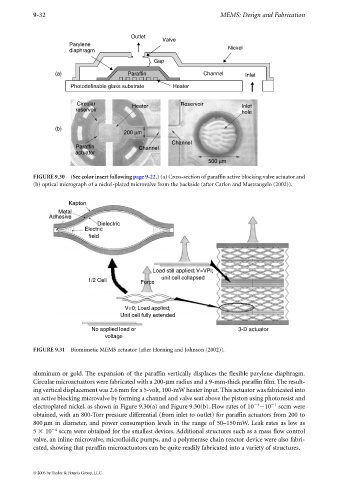
             FIGURE 9.30 (See color insert following page 9-22.) (a) Cross-section of paraffin active blocking valve actuator and
             (b) optical micrograph of a nickel-plated microvalve from the backside (after Carlen and Mastrangelo (2002)).


                         Kapton
                      Metal
                  Adhesive
                                   Dielectric
                               Electric
                                field


                                                       Load still applied; V>VPl;
                                                          unit cell collapsed
                                1/2 Cell
                                                  Force


                                             V=0; Load applied;
                                           Unit cell fully extended

                                 No applied load or                                  3-D actuator
                                      voltage

             FIGURE 9.31 Biomimetic MEMS actuator (after Horning and Johnson (2002)).


             aluminum or gold. The expansion of the paraffin vertically displaces the flexible parylene diaphragm.
             Circular microactuators were fabricated with a 200-µmradius and a 9-mm-thick paraffin film. The result-
             ing vertical displacement was 2.6mm for a 5-volt, 100-mW heater input. This actuator was fabricated into
             an active blocking microvalve by forming a channel and valve seat above the piston using photoresist and
                                                                                           3
             electroplated nickel, as shown in Figure 9.30(a) and Figure 9.30(b). Flow rates of 10  10  1  sccm were
             obtained, with an 800-Torr pressure differential (from inlet to outlet) for paraffin actuators from 200 to
             800µm in diameter, and power consumption levels in the range of 50–150mW. Leak rates as low as
             5   10  4  sccm were obtained for the smallest devices. Additional structures such as a mass flow control
             valve, an inline microvalve, microfluidic pumps, and a polymerase chain reactor device were also fabri-
             cated, showing that paraffin microactuators can be quite readily fabricated into a variety of structures.


             © 2006 by Taylor & Francis Group, LLC

