


Page 325 - Machinery Component Maintenance
P. 325
Baloncing  of’ Machinery  Components   307

                    other words, the larger portion of the tolerance is allotted to the correc-
                    tion plane closest to the CG; however, the ratio of the two tolerance por-
                    tions should never exceed 7:3, even though the plane distance ratio may
                    be higher.
                      For rotors  with correction  plane distance  (b) larger than the bearing
                    span (d), the total tolerance  should be reduced by the factor d/b before
                    any apportioning takes place.
                      For rotors with correction plane distance smaller than V3 of the bearing
                    span and for rotors with two correction planes outboard of one bearing, it
                    is often advisable to measure unbalance and state the tolerance in terms
                    of (quasi-) static and couple unbalance. Satisfactory results can generally
                    be expected  if the  static residual  unbalance is held  within the limits of
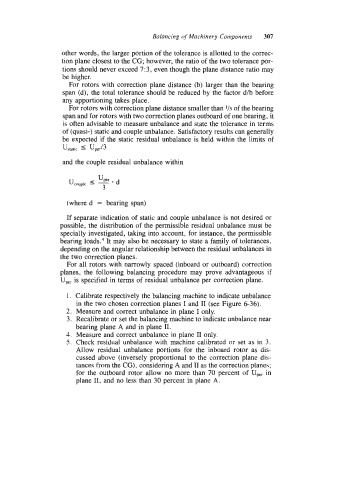
                    Ustaw  5 UpJ3

                    and the couple residual unbalance within


                     (where d  =  bearing span)
                     If separate indication of  static and couple unbalance is not desired or
                   possible,  the distribution  of the permissible  residual unbalance must be
                   specially investigated, taking into account, for instance, the permissible
                   bearing loads.4 It may also be necessary to state a family of tolerances,
                   depending on the angular relationship between the residual unbalances in
                   the two correction planes.
                     For all rotors with narrowly  spaced (inboard or outboard) correction
                   planes,  the  following  balancing  procedure  may  prove  advantageous  if
                   U,,  is specified in terms of residual unbalance per correction plane.

                     1 .  Calibrate respectively the balancing machine to indicate unbalance
                        in the two chosen correction planes I and I1 (see Figure 6-36).
                     2.  Measure and correct unbalance in plane I only.
                     3.  Recalibrate or set the balancing machine to indicate unbalance near
                        bearing plane A and in plane 11.
                     4. Measure and correct unbalance in plane I1 only.
                     5. Check residual  unbalance with  machine calibrated  or set  as in  3.
                        Allow  residual  unbalance  portions  for  the  inboard  rotor  as  dis-
                        cussed  above  (inversely  proportional to  the correction  plane dis-
                        tances from the CG), considering A and I1 as the correction planes;
                        for  the  outboard  rotor  allow  no  more  than  70 percent  of  U,,   in
                        plane 11, and no less than 30 percent in  plane A.

