


Page 326 - Machinery Component Maintenance
P. 326
308    Machinery Component Maintenance and Repair


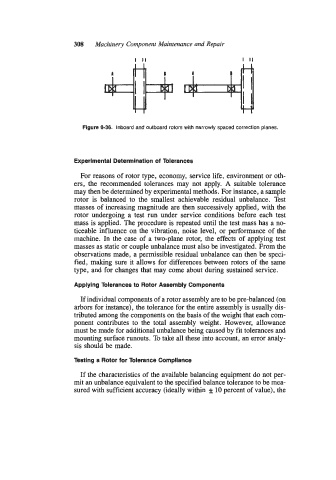
                          Figure 6-36.  Inboard and outboard rotors with narrowly spaced correction planes.


                        Experimental Determination of Tolerances
                         For reasons of rotor type, economy, service life, environment or oth-
                       ers,  the recommended tolerances may  not  apply.  A  suitable tolerance
                        may then be determined by experimental methods. For instance, a sample
                        rotor  is  balanced to  the  smallest  achievable residual  unbalance.  Test
                        masses of  increasing magnitude are then successively applied, with the
                        rotor undergoing a  test  run  under  service conditions before each test
                        mass is applied. The procedure is repeated until the test mass has a no-
                        ticeable influence on the vibration,  noise level, or performance of the
                        machine.  In the case of  a two-plane rotor, the effects of  applying test
                        masses as static or couple unbalance must also be investigated. From the
                        observations made, a permissible residual unbalance can then be speci-
                        fied, making sure it allows for differences between rotors of  the same
                        type, and for changes that may come about during sustained service.

                        Applying Tolerances to Rotor Assembly Components

                         If individual components of a rotor assembly are to be pre-balanced (on
                        arbors for instance), the tolerance for the entire assembly is usually dis-
                        tributed among the components on the basis of the weight that each com-
                        ponent contributes to  the total assembly weight.  However, allowance
                        must be made for additional unbalance being caused by fit tolerances and
                        mounting surface runouts. To take all these into account, an error analy-
                        sis should be made.

                        Testing a Rotor for Tolerance Compliance

                         If the characteristics of the available balancing equipment do not per-
                        mit an unbalance equivalent to the specified balance tolerance to be mea-
                        sured with sufficient accuracy (ideally within * 10 percent of value), the

