


Page 331 - Machinery Component Maintenance
P. 331
Balancing  of  Machinery Components   313

                     Bearing or journal changes.
                     Environmental differences (heat, humidity).
                    l Shipping or handling damage.
                     Aging or stress relieving of components.

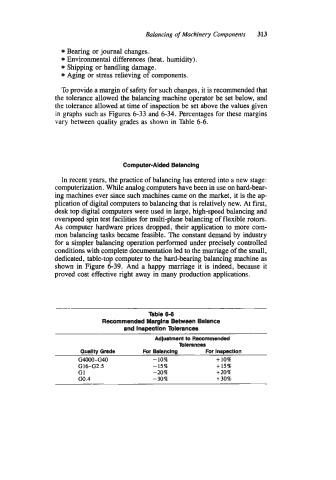
                    To provide a margin of safety for such changes, it is recommended that
                  the tolerance allowed the balancing machine operator be set below, and
                  the tolerance allowed at time of  inspection be set above the values given
                  in graphs such as Figures 6-33 and 6-34. Percentages for these margins
                  vary between quality grades as shown in Table 6-6.


                                      Computer-Aided Balancing

                    In recent years, the practice of balancing has entered into a new stage:
                  computerization. While analog computers have been in use on hard-bear-
                  ing machines ever since such machines came on the market, it is the ap-
                  plication of digital computers to balancing that is relatively new. At first,
                  desk top digital computers were used in large, high-speed balancing and
                  overspeed spin test facilities for multi-plane balancing of flexible rotors.
                  As computer hardware prices dropped, their application to more com-
                  mon balancing tasks became feasible. The constant demand by  industry
                  for a simpler balancing operation performed under precisely controlled
                  conditions with complete documentation led to the marriage of the small,
                  dedicated, table-top computer to the hard-bearing balancing machine as
                  shown in  Figure 6-39. And  a happy  marriage it is indeed, because it
                  proved cost effective right away in many production applications.


                                              Tgble 6-6
                                Recommended Margins Between Balance
                                      and Insmction Tolerances
                                                Adjustment to Recommended
                                                       Tolerances
                         Quality Grade      For Balancing      For Inspection
                         G4000-G40             - 10%              + 10%
                         G 16-G2.5             - 15%              + 15%
                         GI                    -20%                t 20%
                         Go.4                  -302                t 30%

