


Page 339 - Machinery Component Maintenance
P. 339
Balancing of  Machinery  Components   321


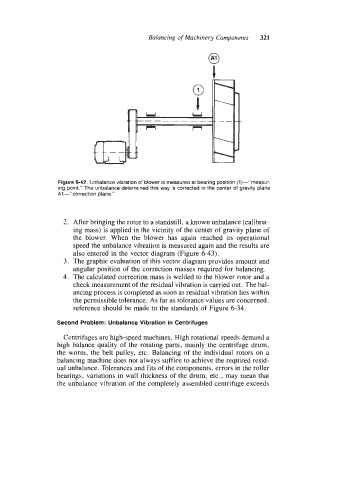
                   Figure 6-42. Unbalance vibration of blower is measurea at bearing position (1)-”rneasur-
                   ing point.”  The unbalance determined this way is corrected in the center of  gravity plane
                   A1 -“correction  plane.”


                    2. After bringing the rotor to a standstill, a known unbalance (calibrat-
                       ing mass) is applied in the vicinity of the center of gravity plane of
                       the  blower.  When  the  blower  has  again  reached  its  operational
                       speed the unbalance vibration is measured again and the results are
                       also entered in the vector diagram (Figure 6-43).
                    3.  The graphic evaluation of this vector diagram provides amount and
                       angular position of the correction masses required for balancing.
                    4.  The calculated correction mass is welded to the blower  rotor and a
                       check measurement of the residual vibration is carried out. The bal-
                       ancing process is completed as soon as residual vibration lies within
                       the permissible tolerance. As far as tolerance values are concerned.
                       reference should be made to the standards of  Figure 6-34.
                  Second Problem: Unbalance Vibration in Centrifuges

                    Centrifuges are high-speed machines. High rotational speeds demand a
                  high  balance  quality of the  rotating  parts.  mainly the  centrifuge drum,
                  the  worm, the  belt pulley,  etc. Balancing of the individual  rotors on  a
                  balancing machine does not always suffice to achieve the required resid-
                  ual unbalance. Tolcrances and fits of the components, errors in the roller
                  bearings,  variations in  wall thickness of the drum, etc., may  mean that
                  the unbalance vibration  of the completely  assembled centrifuge exceeds

