


Page 340 - Machinery Component Maintenance
P. 340
322    Machinery  Component Maintenance and Repair


                        the permissible values. The need to correct this may arise when test run-
                        ning a new centrifuge and after repair and overhaul of older installations.

                        Solution: Field Balancing in Two Planes

                          Disassembly, additional machining, excess costs, and user complaints
                        may be avoided by  rebalancing on the test stand (Figure 6-44) or at the
                        final point  of  installation. Because of  the  geometry  of  the  centrifuge
                        drum, field balancing in two planes is almost always necessary in order
                        to improve the unbalance condition effectively. For this purpose the un-
                        balance vibration is measured at two bearing positions as shown in Fig-
                        ure 6-45 and the unbalance determined in this way  is corrected in two
                        radial planes A1 and A2.
                          Measurement is carried out with a portable electronic balancing instru-
                        ment that indicates the amount and angular position of the unbalance vi-
                        bration for both measuring positions with frequency selectivity. For the
                        evaluation of measured results, graphical methods have been used almost


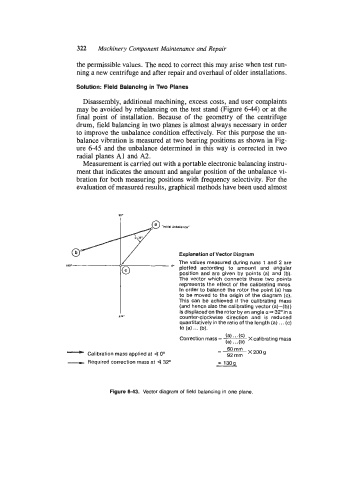
                                      /                 Explanation of Vector Diagram

                                      8              0.   The values measured during runs 1 and 2 are
                                                        plotted  according  to  amount  and  angular
                                                        position and are  given by points (a)  and (b).
                                                        The vector which connects these two  points
                                                        represents the effect of  the calibrating  mass.
                                                        In order to balance the rotor the point (a) has
                                                        to be moved to the origin of the diagram (c).
                                                        This  can  be achieved if  the  calibrating  mass
                                                        (and hence also the calibrating vector (a) -(b))
                                                        is displaced on the rotor bv an anale a-  32Oin a
                                     270-               counter-clockwise  direction  ani is  reduced
                                                        quantitatively in the ratio  of the length (a). . . (c)
                                                        to (a) ... (b).
                                                        Correction  mass = - (a).'.(c)  Xcalibrating mass
                                                                      (a). . . (b)
                                                                   -
                                                                   -
                     - Calibration mass applied at 4 Oo               60mrn  x200g
                                                                      92 mrn
                      - Required correction mass at 4 32'          = 1309


                                  Figure 6-43.  Vector diagram of  field balancing in one plane.

