


Page 459 -
P. 459
458 Part Three  Key System Applications for the Digital Age


                                     •  Acting as change agents, evaluating, initiating, and promoting change projects


                                   REQUIREMENTS OF KNOWLEDGE WORK SYSTEMS

                                   Most knowledge workers rely on office systems, such as word processors, voice
                                   mail, e-mail, videoconferencing, and scheduling systems, which are designed
                                   to increase worker productivity in the office. However, knowledge workers also
                                   require highly specialized knowledge work systems with powerful graphics,
                                   analytical tools, and communications and document management capabilities.
                                     These systems require sufficient computing power to handle the sophisti-
                                   cated graphics or complex calculations necessary for such knowledge work-
                                   ers as scientific researchers, product designers, and financial analysts. Because
                                   knowledge workers are so focused on knowledge in the external world, these
                                   systems also must give the worker quick and easy access to external databases.
                                   They typically feature user-friendly interfaces that enable users to perform
                                   needed tasks without having to spend a great deal of time learning how to use
                                   the system. Knowledge workers are highly paid—wasting a knowledge work-
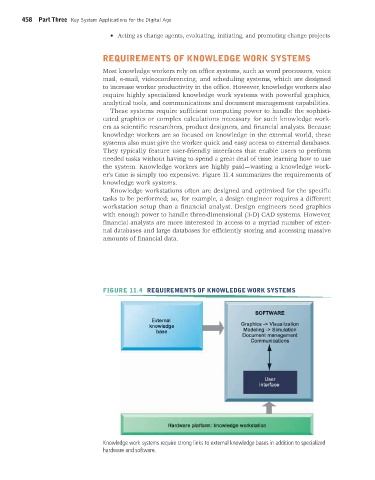
                                   er’s time is simply too expensive. Figure 11.4 summarizes the requirements of
                                   knowledge work systems.
                                     Knowledge workstations often are designed and optimized for the specific
                                   tasks to be performed; so, for example, a design engineer requires a different
                                   workstation setup than a financial analyst. Design engineers need graphics
                                   with enough power to handle three-dimensional (3-D) CAD systems. However,
                                   financial analysts are more interested in access to a myriad number of exter-
                                   nal databases and large databases for efficiently storing and accessing massive
                                   amounts of financial data.


                                         FIGURE 11.4  REQUIREMENTS OF KNOWLEDGE WORK SYSTEMS


                                   Knowledge work systems require strong links to external knowledge bases in addition to specialized
                                   hardware and software.


   MIS_13_Ch_11 Global.indd   458                                                                             1/17/2013   2:30:02 PM

