


Page 208 - Marine Structural Design
P. 208
184                                                     Part II Ultimate Strength

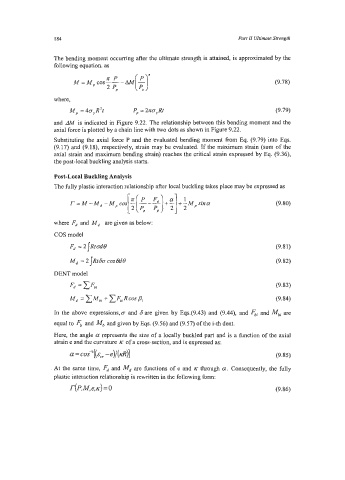
                 The bending moment occurring after the ultimate strength is attained, is approximated by the
                 following equation. as

                                                                                     (9.78)

                 where,
                      M, = 4a,R2t         P,  = 2~t~,Rt                               (9.79)

                  and AM is indicated in Figure 9.22.  The relationship between this bending moment and the
                  axial force is plotted by a chain line with two dots as shown in Figure 9.22.
                  Substituting the axial force P and the evaluated bending moment from Eq. (9.79)  into Eqs.
                  (9.17) and (9.18),  respectively, strain may be evaluated. If the maximum strain (sum of the
                  axial strain and maximum bending strain) reaches the critical strain expressed by Eq. (9.36),
                  the post-local buckling analysis starts.

                  Post-Local Buckling Analysis
                  The filly plastic interaction relationship after local buckling takes place may be expressed as

                                                                                      (9.80)


                  where Fd and M,  are given as below:
                  COS model
                       Fd = 2jRtd9                                                    (9.81)

                       M, = 2JRt60cos&ie                                              (9.82)

                  DENT model
                       ~d  = CFbi                                                     (9.83)
                       M, = CMbi + C FbiR COS pi                                      (9.84)

                  In the above expressions, d and S are given by Eqs.(9,43) and (9.44), and ei and Mbi  are
                  equal to 4 and Mb and given by Eqs. (9.56) and (9.57) of the i-th dent.

                  Here, the angle a represents the size of a locally buckled part and is a function of the axial
                  strain e and the curvature K of a cross-section, and is expressed as:
                       a =cos'[(E,, -e)/(&)]                                          (9.85)

                  At  the same time, 4 and Md are functions of e and  K through a. Consequently, the  fully
                  plastic interaction relationship is rewritten in the following form:
                       I-(P,M,e, K) = 0                                               (9.86)

