


Page 440 - Marketing Management
P. 440
DESIGNING AND MANAGING INTEGRATED MARKETING CHANNELS | CHAPTER 15             417


           and small specialty stores.To work most effectively with these retail channels, Philips has created an organiza-
           tion designed around its retail customers, with dedicated global key account managers serving leading retailers
           such as Best Buy, Carrefour, Costco, Dixons, and Tesco. Like many modern firms, Philips also sells via the Web
           through its own online store as well as through a number of other online retailers. 5


              In multichannel marketing, each channel targets a different segment of buyers, or different need
           states for one buyer, and delivers the right products in the right places in the right way at the least
           cost. When this doesn’t happen, there can be channel conflict, excessive cost, or insufficient
           demand. Launched in 1976, Dial-a-Mattress successfully grew for three decades by selling mat-
           tresses directly over the phone and, later, the Internet. A major expansion into 50 brick-and-mortar
           stores in major metro areas was a failure, however. Secondary locations, chosen because manage-
           ment considered prime locations too expensive, could not generate enough customer traffic. The
           company eventually declared bankruptcy. 6
              On the other hand, when a major catalog and Internet retailer invested significantly in brick-
           and-mortar stores, different results emerged. Customers near the store purchased through the
           catalog less frequently, but their Internet purchases were unchanged. As it turned out, customers
           who liked to spend time browsing were happy to either use a catalog or visit the store; those channels
           were interchangeable. Customers who used the Internet, on the other hand, were more transaction
           focused and interested in efficiency, so they were less affected by the introduction of stores. Returns
           and exchanges at the stores were found to increase because of ease and accessibility, but extra
           purchases made by customers returning or exchanging at the store offset any revenue deficit.
              Companies that manage hybrid channels clearly must make sure their channels work well
           together and match each target customer’s preferred ways of doing business. Customers expect
           channel integration, which allows them to:
           •   Order a product online and pick it up at a convenient retail location
           •   Return an online-ordered product to a nearby store of the retailer
           •   Receive discounts and promotional offers based on total online and offline purchases
           Here’s a company that has carefully managed its multiple channels. We discuss the topic of optimal
           channel integration in greater detail later.


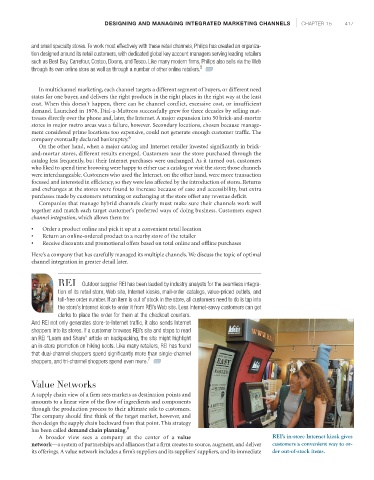
                    REI Outdoor supplier REI has been lauded by industry analysts for the seamless integra-
                    tion of its retail store, Web site, Internet kiosks, mail-order catalogs, value-priced outlets, and
                    toll-free order number. If an item is out of stock in the store, all customers need to do is tap into
                    the store’s Internet kiosk to order it from REI’s Web site. Less Internet-savvy customers can get
                    clerks to place the order for them at the checkout counters.
           And REI not only generates store-to-Internet traffic, it also sends Internet
           shoppers into its stores. If a customer browses REI’s site and stops to read
           an REI “Learn and Share” article on backpacking, the site might highlight
           an in-store promotion on hiking boots. Like many retailers, REI has found
           that dual-channel shoppers spend significantly more than single-channel
           shoppers, and tri-channel shoppers spend even more. 7


           Value Networks
           A supply chain view of a firm sees markets as destination points and
           amounts to a linear view of the flow of ingredients and components
           through the production process to their ultimate sale to customers.
           The company should first think of the target market, however, and
           then design the supply chain backward from that point. This strategy
           has been called demand chain planning. 8
              A broader view sees a company at the center of a  value                    REI’s in-store Internet kiosk gives
           network—a system of partnerships and alliances that a firm creates to source, augment, and deliver  customers a convenient way to or-
           its offerings.A value network includes a firm’s suppliers and its suppliers’suppliers, and its immediate  der out-of-stock items.

