


Page 444 - Marketing Management
P. 444
DESIGNING AND MANAGING INTEGRATED MARKETING CHANNELS | CHAPTER 15             421


           longer “infomercials”; Red Envelope sells gifts online; and Apple
           sells computers and other consumer electronics through its own
           stores. Many of these firms now sell directly to customers in more
           ways than one, via online, catalogs, etc.
              A one-level channel contains one selling intermediary, such as a
           retailer. A two-level channel contains two intermediaries. In con-
           sumer markets, these are typically a wholesaler and a retailer. A
           three-level channel contains three intermediaries. In the meatpacking
           industry, wholesalers sell to jobbers, essentially small-scale whole-
           salers, who sell to small retailers. In Japan, food distribution may in-
           clude as many as six levels. Obtaining information about end users
           and exercising control becomes more difficult for the producer as
           the number of channel levels increases.
              Figure 15.2(b) shows channels commonly used in B2B mar-
           keting. An industrial-goods manufacturer can use its sales force
           to sell directly to industrial customers; or it can sell to industrial
           distributors who sell to industrial customers; or it can sell
           through manufacturer’s representatives or its own sales branches
           directly to industrial customers, or indirectly to industrial cus-
           tomers through industrial distributors. Zero-, one-, and two-level
           marketing channels are quite common.
              Channels normally describe a forward movement of products
           from source to user, but reverse-flow channels are also important
           (1) to reuse products or containers (such as refillable chemical-carrying
           drums), (2) to refurbish products for resale (such as circuit boards or
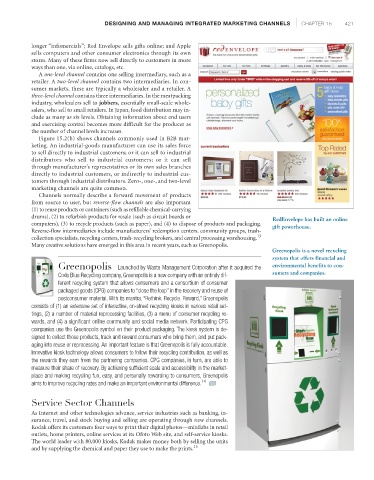
                                                                                         RedEnvelope has built an online
           computers), (3) to recycle products (such as paper), and (4) to dispose of products and packaging.  gift powerhouse.
           Reverse-flow intermediaries include manufacturers’ redemption centers, community groups, trash-
           collection specialists, recycling centers, trash-recycling brokers, and central processing warehousing. 13
           Many creative solutions have emerged in this area in recent years, such as Greenopolis.
                                                                                         Greenopolis is a novel recycling
                                                                                         system that offers financial and
                                                                                         environmental benefits to con-
                    Greenopolis Launched by Waste Management Corporation after it acquired the
               Sony  Code Blue Recycling company, Greenopolis is a new company with an entirely dif-  sumers and companies.
                    ferent recycling system that allows consumers and a consortium of consumer
                    packaged goods (CPG) companies to “close the loop” in the recovery and reuse of
                    postconsumer material. With its mantra, “Rethink. Recycle. Reward,” Greenopolis
           consists of (1) an extensive set of interactive, on-street recycling kiosks in various retail set-
           tings, (2) a number of material reprocessing facilities, (3) a menu of consumer recycling re-
           wards, and (4) a significant online community and social media network. Participating CPG
           companies use the Greenopolis symbol on their product packaging. The kiosk system is de-
           signed to collect those products, track and reward consumers who bring them, and put pack-
           aging into reuse or reprocessing.An important feature is that Greenopolis is fully accountable.
           Innovative kiosk technology allows consumers to follow their recycling contribution, as well as
           the rewards they earn from the partnering companies. CPG companies, in turn, are able to
           measure their share of recovery. By achieving sufficient scale and accessibility in the market-
           place and making recycling fun, easy, and personally rewarding to consumers, Greenopolis
           aims to improve recycling rates and make an important environmental difference. 14


           Service Sector Channels
           As Internet and other technologies advance, service industries such as banking, in-
           surance, travel, and stock buying and selling are operating through new channels.
           Kodak offers its customers four ways to print their digital photos—minilabs in retail
           outlets, home printers, online services at its Ofoto Web site, and self-service kiosks.
           The world leader with 80,000 kiosks, Kodak makes money both by selling the units
           and by supplying the chemical and paper they use to make the prints. 15

