


Page 449 - Marketing Management
P. 449
426    PART 6    DELIVERING VALUE


                                      TERMS AND RESPONSIBILITIES OF CHANNEL MEMBERS Each channel member
                                      must be treated respectfully and given the opportunity to be profitable. The main elements in the
                                      “trade-relations mix” are price policies, conditions of sale, territorial rights, and specific services to
                                      be performed by each party.
                                      •  Price policy calls for the producer to establish a price list and schedule of discounts and
                                         allowances that intermediaries see as equitable and sufficient.
                                      •  Conditions of sale refers to payment terms and producer guarantees. Most producers grant
                                         cash discounts to distributors for early payment. They might also offer a guarantee against
                                         defective merchandise or price declines, creating an incentive to buy larger quantities.
                                      •  Distributors’ territorial rights define the distributors’ territories and the terms under which
                                         the producer will enfranchise other distributors. Distributors normally expect to receive full
                                         credit for all sales in their territory, whether or not they did the selling.
                                      •  Mutual services and responsibilities must be carefully spelled out, especially in franchised and
                                         exclusive-agency channels.McDonald’s provides franchisees with a building,promotional support,
                                         a record-keeping system, training, and general administrative and technical assistance. In turn,
                                         franchisees are expected to satisfy company standards for the physical facilities,cooperate with new
                                         promotional programs, furnish requested information, and buy supplies from specified vendors.

                                      Evaluating Major Channel Alternatives
                                      Each channel alternative needs to be evaluated against economic, control, and adaptive criteria.

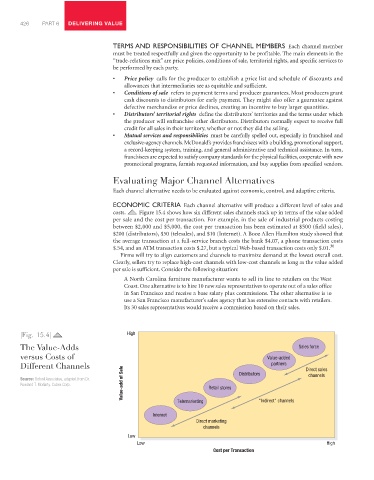
                                      ECONOMIC CRITERIA Each channel alternative will produce a different level of sales and
                                      costs.  Figure 15.4 shows how six different sales channels stack up in terms of the value added
                                      per sale and the cost per transaction. For example, in the sale of industrial products costing
                                      between $2,000 and $5,000, the cost per transaction has been estimated at $500 (field sales),
                                      $200 (distributors), $50 (telesales), and $10 (Internet). A Booz Allen Hamilton study showed that
                                      the average transaction at a full-service branch costs the bank $4.07, a phone transaction costs
                                      $.54, and an ATM transaction costs $.27, but a typical Web-based transaction costs only $.01. 30
                                        Firms will try to align customers and channels to maximize demand at the lowest overall cost.
                                      Clearly, sellers try to replace high-cost channels with low-cost channels as long as the value added
                                      per sale is sufficient. Consider the following situation:
                                         A North Carolina furniture manufacturer wants to sell its line to retailers on the West
                                         Coast. One alternative is to hire 10 new sales representatives to operate out of a sales office
                                         in San Francisco and receive a base salary plus commissions. The other alternative is to
                                         use a San Francisco manufacturer’s sales agency that has extensive contacts with retailers.
                                         Its 30 sales representatives would receive a commission based on their sales.


        |Fig. 15.4|                       High

        The Value-Adds                                                                            Sales force
        versus Costs of                                                                 Value-added
        Different Channels                                                               partners   Direct sales
                                         Value-add of Sale
        Source: Oxford Associates, adapted from Dr.                           Distributors           channels
        Rowland T. Moriarty. Cubex Corp.                             Retail stores


                                                          Telemarketing              "Indirect" channels

                                                  Internet
                                                                Direct marketing
                                                                   channels
                                          Low
                                             Low                                                           High
                                                                      Cost per Transaction

