


Page 448 - Marketing Management
P. 448
DESIGNING AND MANAGING INTEGRATED MARKETING CHANNELS | CHAPTER 15             425


           resellers, and it often includes exclusive dealing arrangements. By granting exclusive distribution,
           the producer hopes to obtain more dedicated and knowledgeable selling. It requires a closer
           partnership between seller and reseller and is used in the distribution of new automobiles, some
           major appliances, and some women’s apparel brands.
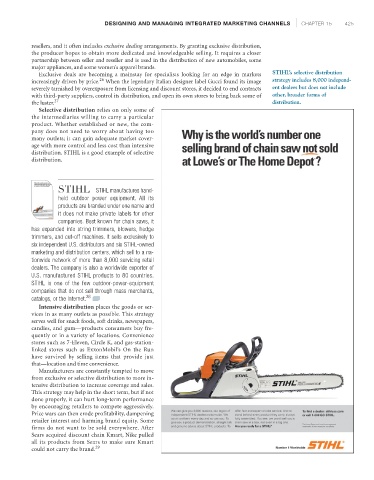
              Exclusive deals are becoming a mainstay for specialists looking for an edge in markets  STIHL’s selective distribution
           increasingly driven by price. 26  When the legendary Italian designer label Gucci found its image  strategy includes 8,000 independ-
           severely tarnished by overexposure from licensing and discount stores, it decided to end contracts  ent dealers but does not include
           with third-party suppliers, control its distribution, and open its own stores to bring back some of  other, broader forms of
           the luster. 27                                                                distribution.
              Selective distribution relies on only some of
           the intermediaries willing to carry a particular
           product. Whether established or new, the com-
           pany does not need to worry about having too
           many outlets; it can gain adequate market cover-
           age with more control and less cost than intensive
           distribution. STIHL is a good example of selective
           distribution.


                    STIHL STIHL manufactures hand-
                    held outdoor power equipment. All its
                    products are branded under one name and
                    it does not make private labels for other
                    companies. Best known for chain saws, it
           has expanded into string trimmers, blowers, hedge
           trimmers, and cut-off machines. It sells exclusively to
           six independent U.S. distributors and six STIHL-owned
           marketing and distribution centers, which sell to a na-
           tionwide network of more than 8,000 servicing retail
           dealers. The company is also a worldwide exporter of
           U.S. manufactured STIHL products to 80 countries.
           STIHL is one of the few outdoor-power-equipment
           companies that do not sell through mass merchants,
           catalogs, or the Internet. 28
              Intensive distribution places the goods or ser-
           vices in as many outlets as possible. This strategy
           serves well for snack foods, soft drinks, newspapers,
           candies, and gum—products consumers buy fre-
           quently or in a variety of locations. Convenience
           stores such as 7-Eleven, Circle K, and gas-station-
           linked stores such as ExxonMobil’s On the Run
           have survived by selling items that provide just
           that—location and time convenience.
              Manufacturers are constantly tempted to move
           from exclusive or selective distribution to more in-
           tensive distribution to increase coverage and sales.
           This strategy may help in the short term, but if not
           done properly, it can hurt long-term performance
           by encouraging retailers to compete aggressively.
           Price wars can then erode profitability, dampening
           retailer interest and harming brand equity. Some
           firms do not want to be sold everywhere. After
           Sears acquired discount chain Kmart, Nike pulled
           all its products from Sears to make sure Kmart
           could not carry the brand. 29

