


Page 446 - Marketing Management
P. 446
DESIGNING AND MANAGING INTEGRATED MARKETING CHANNELS | CHAPTER 15             423


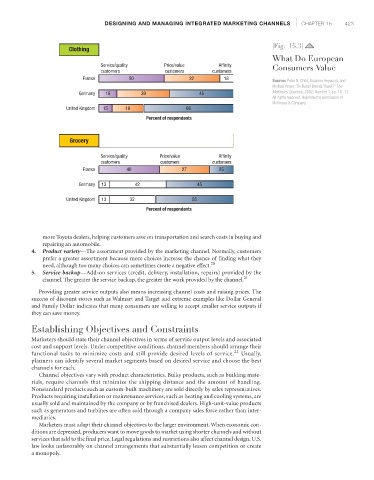
                                                                                         |Fig. 15.3|
                       Clothing
                                                                                         What Do European
                                  Service/quality     Price/value       Affinity         Consumers Value
                                  customers           customers       customers
                            France         50                 32          18
                                                                                         Source: Peter N. Child, Suzanne Heywood, and
                                                                                         Michael Kliger, “Do Retail Brands Travel?” The
                           Germany  16         39                 45                     McKinsley Quarterly, 2002, Number 1, pp. 11–13.
                                                                                         All rights reserved. Reprinted by permission of
                                                                                         McKinsey & Company.
                      United Kingdom  15  19                 66
                                                Percent of respondents


                        Grocery

                                  Service/quality    Price/value        Affinity
                                  customers          customers        customers
                            France        40                27          25

                           Germany  13       42                  45

                      United Kingdom  13   32                  55
                                                Percent of respondents


               more Toyota dealers, helping customers save on transportation and search costs in buying and
               repairing an automobile.
           4.  Product variety—The assortment provided by the marketing channel. Normally, customers
               prefer a greater assortment because more choices increase the chance of finding what they
               need, although too many choices can sometimes create a negative effect. 20
           5.  Service backup—Add-on services (credit, delivery, installation, repairs) provided by the
               channel. The greater the service backup, the greater the work provided by the channel. 21
              Providing greater service outputs also means increasing channel costs and raising prices. The
           success of discount stores such as Walmart and Target and extreme examples like Dollar General
           and Family Dollar indicates that many consumers are willing to accept smaller service outputs if
           they can save money.

           Establishing Objectives and Constraints
           Marketers should state their channel objectives in terms of service output levels and associated
           cost and support levels. Under competitive conditions, channel members should arrange their
           functional tasks to minimize costs and still provide desired levels of service. 22  Usually,
           planners can identify several market segments based on desired service and choose the best
           channels for each.
              Channel objectives vary with product characteristics. Bulky products, such as building mate-
           rials, require channels that minimize the shipping distance and the amount of handling.
           Nonstandard products such as custom-built machinery are sold directly by sales representatives.
           Products requiring installation or maintenance services, such as heating and cooling systems, are
           usually sold and maintained by the company or by franchised dealers. High-unit-value products
           such as generators and turbines are often sold through a company sales force rather than inter-
           mediaries.
              Marketers must adapt their channel objectives to the larger environment. When economic con-
           ditions are depressed, producers want to move goods to market using shorter channels and without
           services that add to the final price. Legal regulations and restrictions also affect channel design. U.S.
           law looks unfavorably on channel arrangements that substantially lessen competition or create
           amonopoly.

