


Page 445 - Marketing Management
P. 445
422    PART 6    DELIVERING VALUE


                                        Marketing channels also keep changing in “person marketing.” Besides live and programmed enter-
                                      tainment, entertainers, musicians, and other artists can reach prospective and existing fans online in
                                      many ways—their own Web sites, social community sites such as Facebook and Twitter, and third-party
                                      Web sites. Politicians also must choose a mix of channels—mass media, rallies, coffee hours, spot TV
                                      ads, direct mail, billboards, faxes, e-mail, blogs, podcasts,Web sites, and social networking sites—for de-
                                      livering their messages to voters.
                                        Nonprofit service organizations such as schools develop “educational-dissemination systems”
                                      and hospitals develop “health-delivery systems.”These institutions must figure out agencies and lo-
                                      cations for reaching a far-flung population.


                                              Cleveland Clinic          One of the largest and most respected hospitals in the
                                              country, Cleveland Clinic, provides medical care in a variety of ways and settings. The main
                                              campus in Cleveland, whose 50 buildings occupy 166 acres, is the hub for patient care, re-
                                              search, and education. Cleveland Clinic also operates 15 family primary-care centers in the
                                              suburbs. Eight hospitals extend the clinic’s reach in Northeast Ohio. Community outreach pro-
                                      grams in all these areas provide education and free health screenings. Cleveland Clinic also offers major
                                      medical care in Florida,Toronto, and, as of 2012,Abu Dhabi. It has a suite of secure online health services
                                                            for both patients and physicians and is developing partnerships with
                                                            Google and Microsoft to further its Internet capabilities. 16


                                                            Channel-Design

                                                            Decisions


                                                            To design a marketing channel system, marketers analyze customer
                                                            needs and wants, establish channel objectives and constraints, and
                                                            identify and evaluate major channel alternatives.


                                                            Analyzing Customer Needs and Wants
                                                            Consumers may choose the channels they prefer based on price,
                                                            product assortment, and convenience, as well as their own shop-
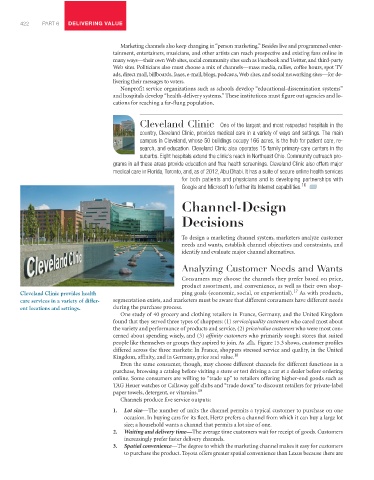
        Cleveland Clinic provides health                    ping goals (economic, social, or experiential). 17  As with products,
        care services in a variety of differ-  segmentation exists, and marketers must be aware that different consumers have different needs
        ent locations and settings.   during the purchase process.
                                        One study of 40 grocery and clothing retailers in France, Germany, and the United Kingdom
                                      found that they served three types of shoppers: (1) service/quality customers who cared most about
                                      the variety and performance of products and service, (2) price/value customers who were most con-
                                      cerned about spending wisely, and (3) affinity customers who primarily sought stores that suited
                                      people like themselves or groups they aspired to join. As   Figure 15.3 shows, customer profiles
                                      differed across the three markets: In France, shoppers stressed service and quality, in the United
                                      Kingdom, affinity, and in Germany, price and value. 18
                                        Even the same consumer, though, may choose different channels for different functions in a
                                      purchase, browsing a catalog before visiting a store or test driving a car at a dealer before ordering
                                      online. Some consumers are willing to “trade up” to retailers offering higher-end goods such as
                                      TAG Heuer watches or Callaway golf clubs and “trade down” to discount retailers for private-label
                                      paper towels, detergent, or vitamins. 19
                                        Channels produce five service outputs:
                                      1.  Lot size—The number of units the channel permits a typical customer to purchase on one
                                         occasion. In buying cars for its fleet, Hertz prefers a channel from which it can buy a large lot
                                         size; a household wants a channel that permits a lot size of one.
                                      2.  Waiting and delivery time—The average time customers wait for receipt of goods. Customers
                                         increasingly prefer faster delivery channels.
                                      3.  Spatial convenience—The degree to which the marketing channel makes it easy for customers
                                         to purchase the product. Toyota offers greater spatial convenience than Lexus because there are

