


Page 450 - Marketing Management
P. 450
DESIGNING AND MANAGING INTEGRATED MARKETING CHANNELS | CHAPTER 15             427


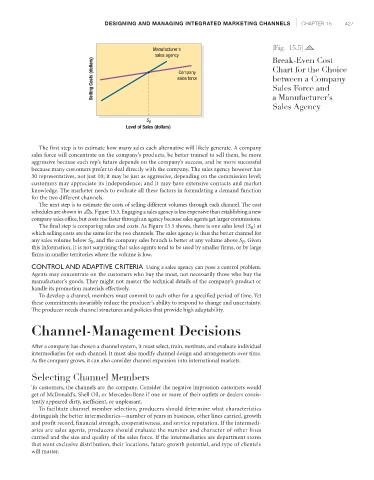
                                                   Manufacturer's                        |Fig. 15.5|
                                                   sales agency                          Break-Even Cost
                               Selling Costs (dollars)    sales force                    Chart for the Choice
                                                           Company
                                                                                         between a Company
                                                                                         Sales Force and
                                                                                         a Manufacturer’s
                                                                                         Sales Agency

                                                S B
                                          Level of Sales (dollars)


              The first step is to estimate how many sales each alternative will likely generate. A company
           sales force will concentrate on the company’s products, be better trained to sell them, be more
           aggressive because each rep’s future depends on the company’s success, and be more successful
           because many customers prefer to deal directly with the company. The sales agency however has
           30 representatives, not just 10; it may be just as aggressive, depending on the commission level;
           customers may appreciate its independence; and it may have extensive contacts and market
           knowledge. The marketer needs to evaluate all these factors in formulating a demand function
           for the two different channels.
              The next step is to estimate the costs of selling different volumes through each channel. The cost
           schedules are shown in   Figure 15.5.Engaging a sales agency is less expensive than establishing a new
           company sales office,but costs rise faster through an agency because sales agents get larger commissions.
              The final step is comparing sales and costs. As Figure 15.5 shows, there is one sales level (S B ) at
           which selling costs are the same for the two channels. The sales agency is thus the better channel for
           any sales volume below S B , and the company sales branch is better at any volume above S B .Given
           this information, it is not surprising that sales agents tend to be used by smaller firms, or by large
           firms in smaller territories where the volume is low.

           CONTROL AND ADAPTIVE CRITERIA Using a sales agency can pose a control problem.
           Agents may concentrate on the customers who buy the most, not necessarily those who buy the
           manufacturer’s goods. They might not master the technical details of the company’s product or
           handle its promotion materials effectively.
              To develop a channel, members must commit to each other for a specified period of time. Yet
           these commitments invariably reduce the producer’s ability to respond to change and uncertainty.
           The producer needs channel structures and policies that provide high adaptability.


           Channel-Management Decisions


           After a company has chosen a channel system, it must select, train, motivate, and evaluate individual
           intermediaries for each channel. It must also modify channel design and arrangements over time.
           As the company grows, it can also consider channel expansion into international markets.


           Selecting Channel Members
           To customers, the channels are the company. Consider the negative impression customers would
           get of McDonald’s, Shell Oil, or Mercedes-Benz if one or more of their outlets or dealers consis-
           tently appeared dirty, inefficient, or unpleasant.
              To facilitate channel member selection, producers should determine what characteristics
           distinguish the better intermediaries—number of years in business, other lines carried, growth
           and profit record, financial strength, cooperativeness, and service reputation. If the intermedi-
           aries are sales agents, producers should evaluate the number and character of other lines
           carried and the size and quality of the sales force. If the intermediaries are department stores
           that want exclusive distribution, their locations, future growth potential, and type of clientele
           will matter.

