


Page 447 - Marketing Management
P. 447
424    PART 6    DELIVERING VALUE


                                        In entering new markets, firms often closely observe what other firms are doing. France’s
                                      Auchan considered the presence of its French rivals Leclerc and Casino in Poland as key to its deci-
                                                            23
                                      sion to also enter that market. Apple’s channel objectives of creating a dynamic retail experience
                                      for consumers was not being met by existing channels, so it chose to open it own stores. 24


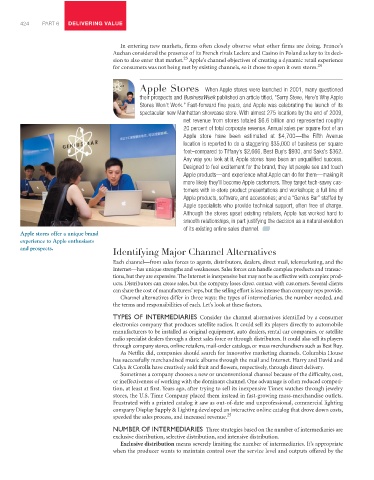
                                              Apple Stores         When Apple stores were launched in 2001, many questioned
                                              their prospects and BusinessWeek published an article titled, “Sorry Steve, Here’s Why Apple
                                              Stores Won’t Work.” Fast-forward five years, and Apple was celebrating the launch of its
                                              spectacular new Manhattan showcase store. With almost 275 locations by the end of 2009,
                                                            net revenue from stores totaled $6.6 billion and represented roughly
                                                            20 percent of total corporate revenue. Annual sales per square foot of an
                                                            Apple store have been estimated at $4,700—the Fifth  Avenue
                                                            location is reported to do a staggering $35,000 of business per square
                                                            foot–compared to Tiffany’s $2,666, Best Buy’s $930, and Saks’s $362.
                                                            Any way you look at it, Apple stores have been an unqualified success.
                                                            Designed to fuel excitement for the brand, they let people see and touch
                                                            Apple products—and experience what Apple can do for them—making it
                                                            more likely they’ll become Apple customers. They target tech-savvy cus-
                                                            tomers with in-store product presentations and workshops; a full line of
                                                            Apple products, software, and accessories; and a “Genius Bar” staffed by
                                                            Apple specialists who provide technical support, often free of charge.
                                                            Although the stores upset existing retailers, Apple has worked hard to
                                                            smooth relationships, in part justifying the decision as a natural evolution
                                                            of its existing online sales channel.
        Apple stores offer a unique brand
        experience to Apple enthusiasts
        and prospects.
                                      Identifying Major Channel Alternatives
                                      Each channel—from sales forces to agents, distributors, dealers, direct mail, telemarketing, and the
                                      Internet—has unique strengths and weaknesses. Sales forces can handle complex products and transac-
                                      tions,but they are expensive.The Internet is inexpensive but may not be as effective with complex prod-
                                      ucts. Distributors can create sales, but the company loses direct contact with customers. Several clients
                                      can share the cost of manufacturers’reps,but the selling effort is less intense than company reps provide.
                                        Channel alternatives differ in three ways: the types of intermediaries, the number needed, and
                                      the terms and responsibilities of each. Let’s look at these factors.

                                      TYPES OF INTERMEDIARIES Consider the channel alternatives identified by a consumer
                                      electronics company that produces satellite radios. It could sell its players directly to automobile
                                      manufacturers to be installed as original equipment, auto dealers, rental car companies, or satellite
                                      radio specialist dealers through a direct sales force or through distributors. It could also sell its players
                                      through company stores, online retailers, mail-order catalogs, or mass merchandisers such as Best Buy.
                                        As Netflix did, companies should search for innovative marketing channels. Columbia House
                                      has successfully merchandised music albums through the mail and Internet. Harry and David and
                                      Calyx & Corolla have creatively sold fruit and flowers, respectively, through direct delivery.
                                        Sometimes a company chooses a new or unconventional channel because of the difficulty, cost,
                                      or ineffectiveness of working with the dominant channel. One advantage is often reduced competi-
                                      tion, at least at first. Years ago, after trying to sell its inexpensive Timex watches through jewelry
                                      stores, the U.S. Time Company placed them instead in fast-growing mass-merchandise outlets.
                                      Frustrated with a printed catalog it saw as out-of-date and unprofessional, commercial lighting
                                      company Display Supply & Lighting developed an interactive online catalog that drove down costs,
                                      speeded the sales process, and increased revenue. 25
                                      NUMBER OF INTERMEDIARIES Three strategies based on the number of intermediaries are
                                      exclusive distribution, selective distribution, and intensive distribution.
                                        Exclusive distribution means severely limiting the number of intermediaries. It’s appropriate
                                      when the producer wants to maintain control over the service level and outputs offered by the

