


Page 308 - Materials Science and Engineering An Introduction
P. 308
280   •  Chapter 8  /  Failure


                                                           Case


                                   Shot peened
              Stress amplitude                            region
                                                           Core


                                      Normal
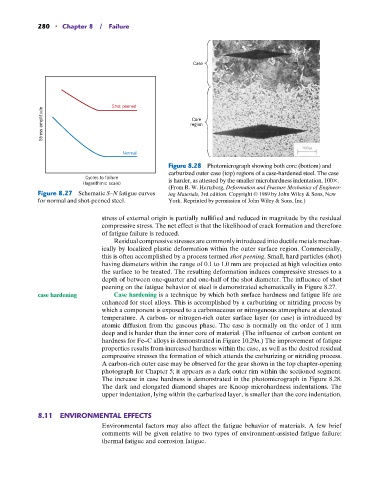
                                                    Figure 8.28  Photomicrograph showing both core (bottom) and
                                                    carburized outer case (top) regions of a case-hardened steel. The case
                           Cycles to failure        is harder, as attested by the smaller microhardness indentation. 100 .
                          (logarithmic scale)
                                                    (From R. W. Hertzberg, Deformation and Fracture Mechanics of Engineer-
            Figure 8.27  Schematic S–N fatigue curves   ing Materials, 3rd edition. Copyright © 1989 by John Wiley & Sons, New
            for normal and shot-peened steel.       York. Reprinted by permission of John Wiley & Sons, Inc.)

                                stress of external origin is partially nullified and reduced in magnitude by the residual
                                compressive stress. The net effect is that the likelihood of crack formation and therefore
                                of fatigue failure is reduced.
                                   Residual compressive stresses are commonly introduced into ductile metals mechan-
                                ically by localized plastic deformation within the outer surface region. Commercially,
                                this is often accomplished by a process termed shot peening. Small, hard particles (shot)
                                having diameters within the range of 0.1 to 1.0 mm are projected at high velocities onto
                                the surface to be treated. The resulting deformation induces compressive stresses to a
                                depth of between one-quarter and one-half of the shot diameter. The influence of shot
                                peening on the fatigue behavior of steel is demonstrated schematically in Figure 8.27.
            case hardening         Case hardening is a technique by which both surface hardness and fatigue life are
                                enhanced for steel alloys. This is accomplished by a carburizing or nitriding process by
                                which a component is exposed to a carbonaceous or nitrogenous atmosphere at elevated
                                temperature. A carbon- or nitrogen-rich outer surface layer (or case) is introduced by
                                atomic diffusion from the gaseous phase. The case is normally on the order of 1 mm
                                deep and is harder than the inner core of material. (The influence of carbon content on
                                hardness for Fe–C alloys is demonstrated in Figure 10.29a.) The improvement of fatigue
                                properties results from increased hardness within the case, as well as the desired residual
                                compressive stresses the formation of which attends the carburizing or nitriding process.
                                A carbon-rich outer case may be observed for the gear shown in the top chapter-opening
                                photograph for Chapter 5; it appears as a dark outer rim within the sectioned segment.
                                The increase in case hardness is demonstrated in the photomicrograph in Figure 8.28.
                                The dark and elongated diamond shapes are Knoop microhardness indentations. The
                                upper indentation, lying within the carburized layer, is smaller than the core indentation.


            8.11   ENVIRONMENTAL EFFECTS
                                Environmental factors may also affect the fatigue behavior of materials. A few brief
                                comments will be given relative to two types of environment-assisted fatigue failure:
                                thermal fatigue and corrosion fatigue.

