


Page 120 - Mechanical Engineers Reference Book
P. 120
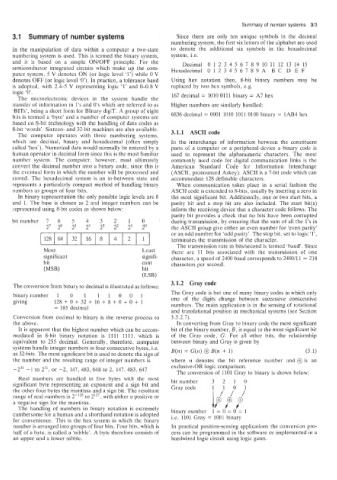
Summary of number systems  3/3
          Summary of  number systems                 Since  there  are  only  ten  unique  symbols  in  the  decimal
                                                    numbering system. the first six letters of the alphabet are used
     In  the  manipulation  of  data  within  a  computer a  two-state   to  denote  the  additional  six  symbols  in  the  hexadecimal
     numbering system is used.  This is termed  the binary  system,   system, i.e.
     and  it  is  based  on  a  simple  OPUOFF  principle.  For  the   Decimal  0  1 2  3  4  5  6  7  8 9  10  11  12  13  14  15
     semiconductor  integrated  circuits  which  make  up  the  com-   Hexadecimal  0  1 2  3  4  5  6  7  8 9  A  B  C  D  E  F
     puter  system, 5 V denotes ON (or logic level ‘1’) while 0 V
     denotes OFF (or logic level ‘0’1. In practice,  a tolerance band   Using  hex  notation  then,  8-bit  binary  numbers  may  be
     is  adopted, with  2.4-5  V  representing  logic ‘1’ and M.8 V   replaced by two hex symbols, e.g.
     logic ‘0’.
      The  microelectronic  devices  in  the  system  handle  the   167 decimal  = 1010 0111 binary  = A7 hex
     transfer of  information in 1’s and 0’s which are referred  to as   Higher numbers  are similarly handled:
     ’BITS’, being a short form for BInary digiT. A group of eight
     bits is termed a ‘byte’ and a number of  computer systems are   6836 decimal  = 0001 1010 1011 0100 binary  = 1AB4 hex
     based on &bit technology with the handling of  data codes as
     8-bit ‘words’. Sixteen- and 32-bit machines are also available.   3.1.1  ASCII code
      The  ‘computer  operates  with  three  numbering  systems,
     which  are  decimal,  binary  and  hexadecimal  (often  simply   In  the  interchange  of  information  between  the  constituent
     called ‘hex’). Numerical data would normally be entered by a   parts of  a  computer or  a  peripheral  device  a binary  code is
     human operator in decimal form since this is the most familiar   used  to  represent  the  alphanumeric  characters.  The  most
     number  system.  The  computer.  however,  must  ultimately   commonly  used  code  for  digital  communication links is  the
     convert  the  decimal  number into a binary  code,  since this is   American  Standard  Code  for  Information  Interchange
     the eventual form in which the number will be processed  and   (ASCII, pronounced Askey). ASCII is a 7-bit code which can
     stored.  The  hexadecimal  system  is  an  in-between  state  and   accommodate  128 definable characters.
     represents a particularly  compact method of  handling binary   When  communication  takes  place  in  a  serial  fashion  the
     numbers  as groups of  four bits.              ASCII code is extended to &bits, usually by inserting a zero in
       In binary representation  the only possible logic levels are 0   the most significant bit. Additionally, one or two start bits, a
     and  1. The base  is chosen  as 2 and integer  numbers  can  be   parity  bit  and  a  stop bit  are  also  included.  The start  bit(s)
     represented using 8-bit codes as shown below:   inform the receiving device that a character code follows. The
                                                    parity bit provides a check that no bits have been  corrupted
     bit number   7   6   5   4   3   2   1   0     during transmission, by ensuring that the sum of  all the 1’s in
               27  26   25   24   23   22   21   20   the ASCII group give either an even number for ‘even parity’
                                                    or an odd number for ‘odd parity’. The stop bit. set to logic ‘l’,
              128  64   32   16   8   4   2   1     terminates  the transmission  of  the character.
                                                     The transmission rate in bitdsecond is termed  ‘baud’. Since
              Most                         Least    there  are  11  bits  associated  with  the  transmission  of  one
              significant                  signifi-   character, a speed of 2400 baud corresponds to 2400/11 = 218
              bit                          cant     characters per second.
              WSBI                         bit
                                           (LSB)
     The conversion from binary to decimal is illustrated as follows:   3.1.2  Gray code
     binary number   1   0   1   1  1  0   0   1    The Gray code is but one of many binary codes in which only
     giving      128 + 0 + 32 + 16 + 8 + 0 + 0 + 1   one  of  the  digits  change  between  successive  consecutive
                 = 185 decimal                      numbers. The main application  is in the sensing of  rotational
                                                    and translational  position  in mechanical systems (see Section
     Conversion from  decimal  to binary is the  reverse process  to   3.5.2.7).
     the above.                                      In converting from Gray to binary code the most significant
       It is aipparent that the highest number which can be accom-   bit of the binary number, B, is equal to the most significant bit
     modated  in  8-bit  binary  notation  is  1111  1111,  which  is   of  the  Gray  code,  G.  For  all  other  bits,  the  relationship
     equivalent  to  255  decimal.  Generally,  therefore,  computer   between binary and Gray is given by
     systems handle integer numbers in four consecutive bytes, i.e.
     as 32-bits. The most significant bit is used to denote the sign of   B(n) = G(n) @ B(n + 1)   (3.1)
     the number and the resulting  range of  integer numbers is   where  n  denotes  the  bit  reference  number  and @ is  an
                                                    exclusive-OR logic comparison.
     -Z3’  -1  to Z3’.  or -2,  147, 483, 648 to 2, 147. 483, 647
                                                     The conversion  of  1101 Gray to binary is shown below:
       Real  numbers  are  handled  in  five  bytes  with  the  most
     significant byte  representing  an  exponent  and  a sign bit  and   bit number   3   2   1  0
     the other four bytes the mantissa and a sign bit. The resultant   Grav code   1  1  0   1
     range of  real numbers is 2-lZx to 212’,  with either a positive or
     a negative sign for the mantissa.
       The handling  of  numbers  in  binary  notation  is  extremely
     cumbersome for a human and a shorthand notation is adopted   binary number  1 = 0  = 0 = 1
                                                    i.e. 1101 Gray = 1001 binary
     for con.venience. This is  the hex  system in which the  binary
     number is arranged into groups of four bits. Four bits, which is   In practical  position-sensing  applications the conversion  pro-
     half of  a byte, is called a ‘nibble’. A byte therefore consists of   cess can be programmed in the software or implemented in a
     an upper  and a lower nibble.                  hardwired  logic circuit using logic gates.

