


Page 123 - Mechanical Engineers Reference Book
P. 123
3/6 Microprocessors, instrumentation and control
           r---li"""'i                                8255PPI is the Intel 8253 chip, which provides three indepen-
            Memory data bus
                                                      dent 16-bit counters, each with a count rate of up to 2.6 MHz.
                                                      The 8253 has various modes of  operation but works basically
                                                      on the same principle as the timers in the 6522VIA.
                                                      3.2.4.5  Direct Memory Access  (DMA)
                                                      In  data-acquisition  systems  involving  analogue  and  digital
                                                      signals suitably conditioned for inputting to a microcomputer
                                                      there is a limitation of  about 100 kHz on the  sampling  rate
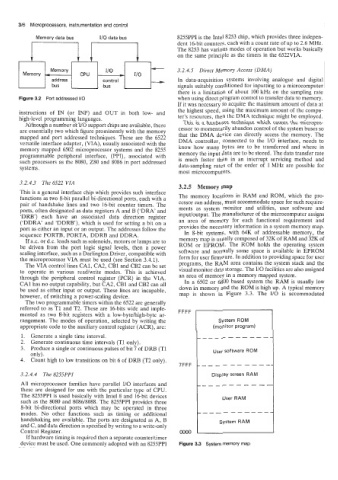
       Figure 3.2  Port addressed I/O                 when using direct program control to transfer data to memory.
                                                      If  it was necessary to acquire the maximum amount of  data at
       instructions  of  IN  (or  INP)  and  OUT  in  both  low-  and   the highest speed, using the maximum amount of the compu-
       high-level programming languages.              ter's resources, then the DMA technique might be employed.
         Although a number of I/O support chips are available, there   This  is  a hardware  technique  which  causes the micropro-
       are essentially two which figure prominently with the memory   cessor to momentarily abandon control of the system buses so
       mapped  and port  addressed  techniques.  These are the  6522   that  the  DMA device  can  directly  access the  memory.  The
       versatile interface adapter, (VIA), usually associated with the   DMA  controller,  connected  to  the  I/O  interface,  needs  to
       memory  mapped 6502 microprocessor  systems  and the 8255   know  how  many  bytes  are  to  be  transferred  and  where  in
       programmable  peripheral  interface,  (PPI),  associated  with   memory the input data are to be stored. The data transfer rate
       such processors as the 8080, 280 and 8086 in port addressed   is  much  faster  than  in  an  interrupt  servicing  method  and
       systems.                                       data-sampling  rates of  the  order of  1 MHz  are possible  for
                                                      most microcomputers.
       3.2.4.3  The 6522 VIA
                                                      3.2.5  Memory map
       This is a general interface chip which provides such interface
       functions as two 8-bit parallel bi-directional ports, each with a   The memory  locations  in  RAM  and  ROM, which  the pro-
       pair  of  handshake lines  and two  16-bit counter  timers.  The   cessor can address, must accommodate space for such require-
       ports,  often designated as data registers A and B ('DRA'  and   ments  as  system  monitor  and  utilities,  user  software  and
       'DRB')  each  have  an  associated  data  direction  register   input/output. The manufacturer  of the microcomputer assigns
       ('DDRA'  and 'DDRB'),  which is used for setting a bit on a   an  area  of  memory  for  each  functional  requirement  and
       port as either an input or an output. The addresses follow the   provides the necessary information in a system memory map.
       sequence PORTB, PORTA, DDRB and DDRA.            In  8-bit  systems,  with  64K  of  addressable  memory,  the
         If  ax. or d.c. loads such as solenoids, motors or lamps are to   memory map is usually composed of  32K of  RAM and 32K of
       be  driven  from  the  port  logic  signal  levels,  then  a  power   ROM  or  EPROM.  The  ROM  holds  the  operating  system
       scaling interface, such as a Darlington Driver, compatible with   software  and  normally  some space  is  available  in  EPROM
       the microprocessor VIA must be used  (see Section 3.4.1).   form for user firmware. In addition to providing space for user
         The VIA control lines CA1, CA2, CB1 and CB2 can be set   programs,  the RAM area contains the system stack and the
       to  operate  in  various  read/write  modes.  This  is  achieved   visual monitor data storage. The 110 facilities are also assigned
       through  the  peripheral  control  register  (PCR)  in  the  VIA.   an area of  memory in a memory mapped system.
       CA1 has no output capability, but CA2, CB1 and CB2 can all   In  a  6502 or 6800 based  system  the  RAM is usually  low
       be used  as either input or output. These lines are incapable,   down in memory and the ROM is high up. A typical memory
       however,  of switching a power-scaling device.   map  is  shown  in  Figure  3.3.  The  I/O  is  accommodated
         The two programmable timers within the 6522 are generally
       referred  to as T1 and T2. These are 16-bits wide and imple-
       mented  as  two  8-bit  registers  with  a  low-byte/high-byte  ar-   FFFF
       rangement. The modes of  operation, selected by writing the   System ROM
       appropriate code to the auxiliary control register (ACR), are:   (monitor program)
       1.  Generate a single time interval.
       2.  Generate continuous time intervals (T1 only).
       3.  Produce a single or continuous pulses of bit 7 of DRB (T1   User software ROM
          only).
       4.  Count high to low transitions on bit 6 of  DRB (T2 only).
                                                      7FFF
       3.2.4.4  The 8255PPI
       All  microprocessor  families have  parallel  110 interfaces  and
       these are designed for use  with the particular  type  of  CPU.
       The 8255PPI is used  basically with Intel 8 and 16-bit devices
       such as the 8080 and 8086/8088. The 8255PPI provides three   User RAM
       8-bit  bi-directional  ports  which  may  be  operated  in  three
       modes.  No  other  functions  such  as  timing  or  additional
       handshaking  are available.  The ports  are designated as A, B
       and C, and data direction is specified by writing to a write-only
       Control Register.                              0000
         If hardware timing is required then a separate countedtimer
       device must be used. One commonly adopted with an 8255PPI   Figure 3.3  System memory map

