


Page 121 - Mechanical Engineers Reference Book
P. 121
314  Microprocessors, instrumentation and control
       3.2  Microprocessors                          Intel  8086  microprocessor,  introduced  in  1979,  has  29 000
                                                     transistors packed on the 225 mm2 chip.
       3.2.1  System architecture                      The main  feature of  the  microprocessor  is  the  arithmetic
                                                     and  logic  unit  (ALU).  The  ALU  allows  the  arithmetical
       Since the mid-1970s there are currently a number of different   manipulation  of  data,  addition  and  subtraction  with  8-bit
       microprocessor  designs  available  in  several  versions.  The   systems and multiplication with 16-bit systems. Logical opera-
       ‘popular’ designs are produced  by  a few manufacturers,  and   tions (AND, OR, etc.) can also be performed. In addition to
       these  include  such  companies  as Intel,  Motorola,  Rockwell.   the  ALU.  the  CPU  contains  a  number  of  temporary  data
       Texas Instruments  and Zilog.                 storage  registers  to  fetch,  decode  and  execute  instructions,
        Microprocessor-based  systems  require  additional  family   and to time  and control  circuits to manage  the internal  and
       support  chips  and.  in  true  digital  form,  all  microelectronic   external  operation  of  the complete microprocessor  system.
       components which constitute a microcomputer are designated   The  processing  power  of  the  CPU  is  influenced  by  such
       numerically rather than  by  name. Some of  the more popular   factors  as  word  length,  instruction  set,  addressing  modes,
       microprocessors  available are as follows:
                                                     number of  available  registers  and information transfer  rates.
          &bit: Binary data handled in a word, 8-bits wide, defining   For word processors or the manipulation of large quantities of
          the accuracy of  the number handling representation.  e.g.   data as in CAD packages,  16- or 32-bit microprocessors  are
          Intel 8080 and 8085                        essential.  In  the  field  of  measurement  and  control,  8-bit
          Motorola 6800 series                       systems are usually adequate.
          Rockwell 6502 series                         The system clock, accurately controlled by  a quartz crystal
          Zilog Z80                                  maintaining a constant frequency, acts as the heartbeat for the
          16-bit: Binary data handled in a word of 16-bits width, e.g.   system and provides  all the timing reference points.
          Intel 8086                                   All the basic components (CPU, memory and I/O) and their
          Motorola 68000                              interconnections  may  reside  in  a  complete  microcomputer
          Zilog 28000                                 system encompassing  the  traditional  keyboard,  monitor,  etc.
                                                      Alternatively,  they may reside on a single card, or even on a
                                                      single chip to give a single-chip microcomputer.
       The  8086 is  one  of  the  most  powerful  and  versatile  16-bit
       microprocessors  available, and it has been widely adopted by
       industry.  Further  enhancements  include  the  32-bit  ver-   3.2.2  Bus structure
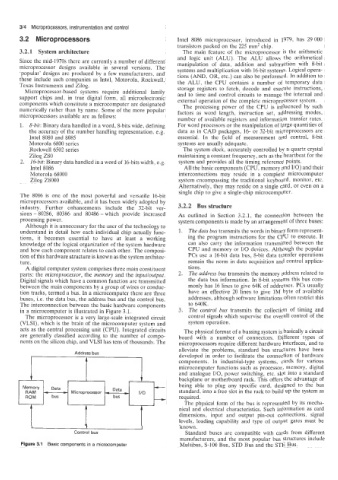
       sions - 80286,  80386  and  80486 - which  provide  increased   As  outlined  in  Section  3.2.1,  the  connection  between  the
       processing power.                             system components is made by an arrangement of three buses:
        Although it is unnecessary for the user of  the technology to
       understand  in  detail  how  each individual  chip actually  func-   1.  The data bus transmits the words in binary form represent-
       tions,  it  becomes  essential  to  have  at  least  a  working   ing the program  instructions for the  CPU to execute.  It
       knowledge of  the logical organization of  the system hardware   can  also  carry  the  information  transmitted  between  ?he
       and how each component relates to each other. The composi-   CPU and memory or I/O devices.  Although the popular
       tion of this hardware structure is known as the system architec-   PCs use  a  16-bit data bus,  8-bit data transfer  operations
       ture.                                            remain the norm in data acquisition  and control applica-
        A digital computer system comprises three main constituent   tions.
       parts:  the microprocessor, the memory and the inputloutput.   2.   The address bus transmits the memory address related to
       Digital signals which have a common function are transmitted   the data bus information.  In 8-bit systems this bus com-
       between the main components by a group of  wires or conduc-   monly has 16 lines to give 64K of  addresses. PCs usually
       tion tracks, termed a bus. In a microcomputer there are three   have  an  effective  20  lines  to  give  1M byte  of  available
       buses, i.e.  the data bus, the address bus and the control bus.   addresses, although software limitations often restrict this
       The interconnection  between the basic hardware  components   to 640K.
       in a microcomputer is illustrated  in Figure 3.1.   3.   The control  bus  transmits  the  collection  of  timing  and
        The microprocessor is a very  large-scale  integrated  circuit   control signals which supervise the overall control of  the
       (VLSI), which is the brain of  the microcomputer system and   system operation.
       acts as the central processing unit  (CPU). Integrated circuits   The physical format of  a bussing system is basically a circuit
       are generally  classified  according  to the  number of  compo-   board  with  a  number  of  connectors.  Different  types  of
       nents on the silicon chip, and VLSI has tens of thousands. The   microprocessors require different hardware interfaces, and to
                                                      alleviate  the  problems,  standard  bus  structures  have  been
                       Address bus                    developed  in order to  facilitate the  connection  of  hardware
                                                      components.  In  industrial-type  systems,  cards  for  various
                                                      microcomputer  functions such  as processor,  memory,  digital
                                                      and analogue I/O, power switching, etc. slot into a standard
          t                                t          backplane  or motherboard rack. This offers the advantage of
        Memory   Data                          -      being  able  to  plug  any  specific  card,  designed  to  the  bus
                                               c-
         RAM   4  - Microprocessor   Data  +   110    standard, into a free slot in the rack to build up the system as
         ROM    bus               bus                 required.
                                                       The physical form of  the bus is represented  by  its mecha-
                          t                t          nical and electrical  characteristics.  Such information  as card
                                                      dimensions,  input  and  output  pin-out  connections,  signal
                                                      levels,  loading  capability  and  type  of  output  gates  must  be
                                                      known.
                       Control bus                      Standard  buses  are  compatible  with  cards  from  different
                                                      manufacturers,  and the  most  popular  bus  structures  include
       Figure 3.1   Basic components in a microcomputer   Multibus, S-100 Bus, STD Bus and the STE Bus.

