


Page 124 - Mechanical Engineers Reference Book
P. 124
Communication standards  3/7
      anywhere  within  the  above  structure  and  varies  from  one   of the two, with the bits denoting the characters of information
      manufacturer  to another.                      travelling  sequentially  along  a  single  path.  In  the  parallel
        The display  screen  RAM is  often  fitted  with  a  moveable   method  the  data word  is sent  as  a parallel  code, invariably
      boundary  in  order to  set  variable  resolution  modes for  gra-   8-bits wide, resulting in a ‘bit parallel, byte serial’ transmission
      phics. Typicaliy, the screen memory need only be 1K for a text   of  information.
      mode  to  give  a  40  X  25  character  display.  This  would  be
      insufficient for computer graphics and a high resolution would   3.3.1  Serial communication
      require 20K of memory to MAP the screen. It should be noted
      that this greatly reduces the amount of RAM available to the   Serial  communication is the most common  method used  for
      user.                                          the interconnection of  a microcomputer to the relatively slow
        8080- and Z80-based systems have a distribution of memory   peripheral  hardware, or between two computers, when trans-
      similar t(a that as shown in Figure 3.3. The ROM, however, is   ferring a low volume  of  information.  The (EIA) RS232C, or
      usually low down and the RAM high up in the memory map.   its  successors  the  RS422  and  RS423,  is  the  most  widely
      The  16-bit PCs,  with  a 20-bit address  bus,  have  1M byte  of   adopted standard employed and connection between  devices
      addressable memory with the RAM comprising the first three   is made via a standard 25-pin connector. This allows communi-
      quarters  and  ROM  occupying  the  last  quarter.  A  general   cation  with  one peripheral  device  only.  Twenty-one  of  the
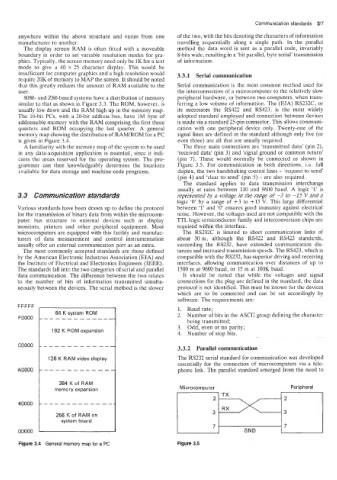
      memory map showing the distribution of RAMiROM for a PC   signal lines are defined in the standard although only five (or
      is given in Figure 3.4.                        even three) are all that are usually required.
        A familiarity with the memory map of the system to be used   The three main  connections are ‘transmitted data’ (pin 2),
      in  any  dlata-acquisition application  is essential,  since it  indi-   ‘received data’ (pin 3) and ’signal ground or common return’
      cates the  areas reserved  for  the operating system. The pro-   (pin  7).  These  would  normally  be  connected  as  shown  in
      grammer  can  then  knowledgeably  determine  the  locations   Figure  3.5.  For  communication  in  both  directions,  Le.  full
       zvailabie for data storage and machine-code programs.   duplex, the two handshaking control lines - ‘request to send’
                                                     (pin 4) and ‘clear to send’ (pin 5) - are also required.
                                                       The  standard  applies  to  data  transmission  interchange
                                                     usually  at  rates  between  110 and  9600 baud.  A  logic  ‘1’ is
      3.3  Communication standards                   represented by a voltage in the range of  -3  to -15  V and a
                                                     logic ‘0’ by  a range  of  +3 to  +15 V. This large differential
      Various standards have been drawn up to define the protocol   between  ‘1’ and ‘0’ ensures good immunity against  electrical
      for the transmission of  binary data from within the microcom-   noise. However, the voltages used are not compatible with the
      puter  bus  structure  to  external  devices  such  as  display   TTL logic semiconductor family and interconversion chips are
      monitors,  printers  and  other  peripheral  equipment.  Most   required  within the interface.
      microcomputers  are equipped with this facility and manufac-   The  RS232C  is  limited  to  short  communication  links  of
      turers  of  data  measurement  and  control  instrumentation   about  30m,  although  the  RS422  and  RS423  standards,
      usually offer an external communication port as an extra.   succeeding  the  RS232,  have  extended  communication  dis-
        The most  commonly  accepted  standards  are those  defined   tances and increased transmission speeds. The RS423, which is
      by the American Electronic Industries Association  (EIA) and   compatible with the RS232, has superior driving and receiving
      the Institute of  Electrical and Electronics Engineers  (IEEE).   interfaces,  allowing  communication  over  distances  of  up  to
      The standards fall into the two categories of serial and parallel   1500 m at 9600 baud, or 15 m at l0OK baud
      data connmunication. The difference between the two relates   It  should  be  noted  that  while  the  voltages  and  signal
      to  the  number  of  bits  of  information  transmitted  simulta-   connections for the plug are defined in the standard, the data
      neously between the devices. The serial method is the slower   protocol is not identified. This must be known for the devices
                                                     which  are  to  be  connected  and  can  be  set  accordingly  by
                                                      software. The requirements  are:
       FFFFF                                          1.  Baud rate;
                                                     2.  Number of bits in the ASCII group defining the character
       FOOOO
                                                        being transmitted;
                                                      3.  Odd, even or no parity;
                 192 K ROM expansion
                                                      4.  Number of  stop bits.
       COO00
                                                      3.3.2  Parallel communication
               128 K RAM video display                The RS232 serial standard for communication was developed
                                                      essentially  for the connection  of  microcomputers  via  a tele-
      AOOOO                                           phone link. The parallel standard emerged from the need to
                   384 K of RAM
                 memory expansion                     Microcomputer                    Peripheral
                                                             1
                                                                   TX
       40000
                  256 K of RAM  on
                   system board
                                                                7
       00000                                                             GND
       Figure 3.4  General memory map for a PC       Figure 3.5

