


Page 129 - Mechanical Engineers Reference Book
P. 129
3/12  Microprocessors, instrumentation and control
             Computer output port
       I                        I


                                                           'Positioner'
                                          Voltage/current   current/pressure
                                          converter        converter


                                                Flexible


                                        Process flow -


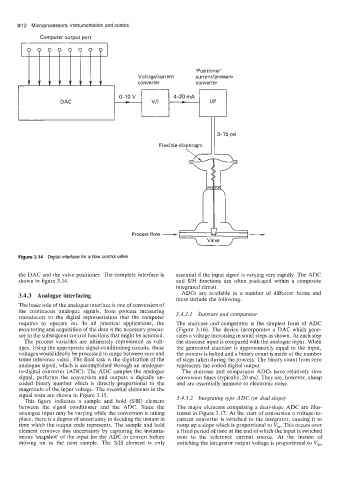
      Figure 3.14  Digital interface for a flow control valve

      the DAC and the valve positioner.  The complete interface is   essential if  the input signal is varying very rapidly. The ADC
      shown in figure 3.14.                          and  S/H functions  are  often  packaged  within  a  composite
                                                     integrated  circuit.
      3.4.3  Analogue interfacing                     ADCs  are  available  in  a  number  of  different  forms  and
                                                     these include the following.
      The basic role of the analogue interface is one of conversion of
      the  continuous  analogue  signals,  from  process  measuring
      transducers  to  the  digital  representation that  the  computer   3.4.3.1  Staircase and comparator
      requires  to  operate  on.  In  all  practical  applications,  the   The staircase  and comparator is the simplest  form of  ADC
      monitoring and acquisition of the data is the necessary precur-   (Figure  3.16). The device  incorporates  a  DAC which gene-
      sor to the subsequent control functions that might be actioned.   rates a voltage increasing in small steps as shown. At each step
        The process  variables  are  ultimately  represented  as volt-   the staircase input is compared with the analogue input. When
      ages. Using the appropriate signal-conditioning circuits, these   the  generated staircase is approximately  equal  to the  input,
      voltages would ideally be processed to range between zero and   the process is halted and a binary count is made of the number
      some reference value. The final task is the digitization of  the   of steps taken during the process. The binary count from zero
      analogue signal, which is accomplished through  an analogue-   represents the coded digital output.
      to-digital  converter  (ADC). The ADC samples the analogue   The staircase  and  comparator ADCs have  relatively  slow
      signal,  performs  the  conversion  and  outputs  a  digitally  en-   conversion times (typically, 20 ms). They are, however, cheap
      coded  binary  number  which  is  directly  proportional  to  the   and are essentially immune to electronic noise.
      magnitude of  the input voltage. The essential elements in the
      signal train are shown in Figure 3.15.         3.4.3.2  Integrating  type ADC (or dual slope)
        This  figure  indicates  a  sample  and  hold  (S/H)  element
      between  the  signal  conditioner  and  the  ADC.  Since  the   The major  elements comprising  a dual-slope ADC are illus-
       analogue input may be varying while the conversion is taking   trated in Figure 3.17. At the start of conversion a voltage-to-
      place, there is a degree of uncertainty in deciding the instant in   current converter  is switched  to the integrator, causing it to
       time which the output code represents. The sample and hold   ramp up a slope which is proportional  to Vi,.  This occurs over
      element removes  this uncertainty  by  capturing  the  instanta-   a fixed period of time at the end of  which the input is switched
      neous 'snapshot'  of  the input for the ADC to convert before   over  to  the  reference  current  source.  At  the  instant  of
      moving  on  to  the  next  sample.  The  S/H  element  is  only   switching the integrator output voltage is proportional to Vi,,

