


Page 131 - Mechanical Engineers Reference Book
P. 131
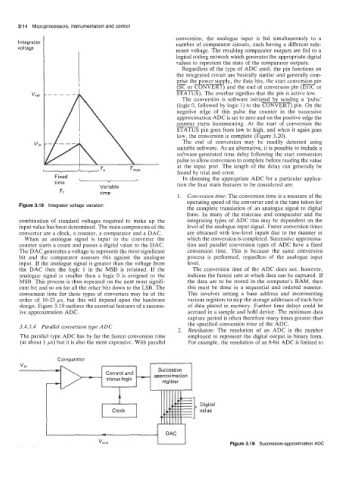
logical coding network which generates the appropriate digital
                                                     values to represent  the state of  the comparator outputs.
                                                       Regardless of  the type of  ADC used, the pin functions on
                                                     the integrated  circuit are basically similar and generally com-
                                                      pr&e  the power supply, the data bits, the start conversionin
                         I                            (SC or CONVERT) and the end of  conversion pin (EOC or


                   ‘f          time
                                                      1.  Conversion time: The conversion time is a measure of the
                                                         operating speed of the converter and is the time taken for
       Figure 3.18  Integrator voltage variation
                                                         the complete translation  of  an analogue  signal to digital
                                                         form. In many  of  the staircase and comparator and  the
       combination  of  standard voltages  required  to  make  up  the   integrating types of  ADC this may be dependent on the
       input value has been determined. The main components of the   level of the analogue input signal. Faster conversion times
       converter are a clock, a counter, a comparator and a DAC.   are obtained  with low-level inputs due to the manner in
         When  an  analogue  signal  is  input  to  the  converter  the   which the conversion is completed. Successive approxima-
       counter starts a count and passes a digital value to the DAC.   tion  and parallel  conversion  types of  ADC have  a fixed
       The DAC generates a voltage to represent the most significant   conversion  time.  This  is  because  the  same  conversion
       bit  and  the  comparator  assesses  this  against  the  analogue   process  is  performed,  regardless  of  the  analogue  input
       input. If  the analogue signal is greater than the voltage from   level.
       the  DAC then  the  logic  1 in  the  MSB  is  retained.  If  the   The conversion time  of  the ADC does  not,  however,
       analogue  signal  is  smaller  then  a  logic 0  is  assigned  to  the   indicate the fastest rate at which data can be captured. If
       MSB. This process is then repeated on the next most signifi-   the data  are  to be stored  in the computer’s RAM, then
       cant bit and so on for all the other bits down to the LSB. The   this  must  be  done in  a  sequential  and  ordered manner.
       conversion time for these types of  converters may be of  the   This  involves  setting  a  base  address  and  incrementing
       order  of  1@25 ps, but  this will  depend  upon  the  hardware   various registers to step the storage addresses of each byte
       design. Figure 3.19 outlines the essential features of  a success-   of  data placed  in memory.  Further time delays could be
       ive approximation  ADC.                           accrued in a sample and hold device. The minimum data
                                                         capture period is often therefore many times greater than
                                                         the specified conversion time of  the ADC.
       3.4.3.4  Parallel conversion type ADC          2.  Resolution:  The  resolution  of  an  ADC is  the  number
       The parallel type ADC has by far the fastest conversion time   employed to represent the digital output in binary form.
       (at about 1 ps) but it is also the most expensive. With parallel   For example, the resolution of an 8-bit ADC is limited to

                  Comparator


                                                             Digital
                                                            value


                                                  DAC
                                                                     Figure 3.1 9  Successive-approximation ADC

