


Page 615 - Mechanical Engineers' Handbook (Volume 2)
P. 615
606   Servoactuators for Closed-Loop Control

                                                   ˙
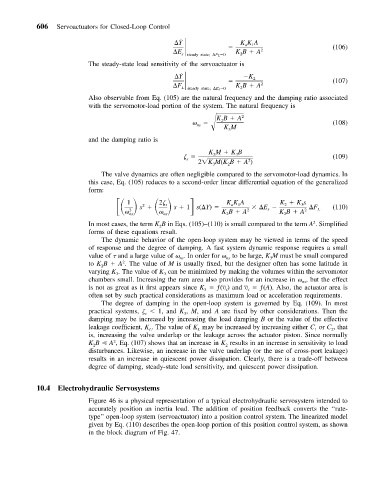
                                                 	Y                 K K A                    (106)
                                                                     a
                                                                       1
                                                 	E               K B   A 2
                                                   s steady state; 	F  0  2
                                                              L
                          The steady-state load sensitivity of the servoactuator is
                                                 	Y ˙                 K 2                    (107)
                                                 	F               K B   A 2
                                                   L steady state; 	E  0  2
                                                              s
                          Also observable from Eq. (105) are the natural frequency and the damping ratio associated
                          with the servomotor-load portion of the system. The natural frequency is
                                                              KB   A 2
                                                              2
                                                               KM                            (108)
                                                        ns
                                                                3
                          and the damping ratio is
                                                           KM   KB
                                                            2     3                          (109)
                                                     s
                                                                      2
                                                        2 KM(KB   A )
                                                            3
                                                                2
                             The valve dynamics are often negligible compared to the servomotor-load dynamics. In
                          this case, Eq. (105) reduces to a second-order linear differential equation of the generalized
                          form:
                                     1  s         	             KKA            K   Ks
                                             2
                                                                                     3
                                               s
                                                                                2
                                                                 a
                                                                   1
                                         2
                                                                           s
                                      2          s   1 s(	Y)    KB   A 2    	E    K B   A 2  	F L  (110)
                                     ns       ns                2               2
                                                                                        2
                          In most cases, the term K B in Eqs. (105)–(110) is small compared to the term A . Simplified
                                             2
                          forms of these equations result.
                             The dynamic behavior of the open-loop system may be viewed in terms of the speed
                          of response and the degree of damping. A fast system dynamic response requires a small
                          value of   and a large value of   . In order for   to be large, K M must be small compared
                                                                ns
                                                   ns
                                                                            3
                                   2
                          to K B   A . The value of M is usually fixed, but the designer often has some latitude in
                             2
                          varying K . The value of K can be minimized by making the volumes within the servomotor
                                 3
                                               3
                          chambers small. Increasing the ram area also provides for an increase in   , but the effect
                                                                                     ns
                          is not as great as it first appears since K   ƒ(V ) and V   ƒ(A). Also, the actuator area is
                                                          3
                                                                i
                                                                      i
                          often set by such practical considerations as maximum load or acceleration requirements.
                             The degree of damping in the open-loop system is governed by Eq. (109). In most
                          practical systems,     1, and K , M, and A are fixed by other considerations. Then the
                                         s
                                                    3
                          damping may be increased by increasing the load damping B or the value of the effective
                          leakage coefficient, K . The value of K may be increased by increasing either C or C , that
                                                                                        1
                                          L
                                                        L
                                                                                             2
                          is, increasing the valve underlap or the leakage across the actuator piston. Since normally
                                 2
                          K B   A , Eq. (107) shows that an increase in K results in an increase in sensitivity to load
                                                                2
                           2
                          disturbances. Likewise, an increase in the valve underlap (or the use of cross-port leakage)
                          results in an increase in quiescent power dissipation. Clearly, there is a trade-off between
                          degree of damping, steady-state load sensitivity, and quiescent power dissipation.
           10.4  Electrohydraulic Servosystems
                          Figure 46 is a physical representation of a typical electrohydraulic servosystem intended to
                          accurately position an inertia load. The addition of position feedback converts the ‘‘rate-
                          type’’ open-loop system (servoactuator) into a position control system. The linearized model
                          given by Eq. (110) describes the open-loop portion of this position control system, as shown
                          in the block diagram of Fig. 47.

