


Page 807 - Mechanical Engineers' Handbook (Volume 2)
P. 807
798   Neural Networks in Feedback Control Systems

                          to find a regression matrix. This is a consequence of the NN universal approximation prop-
                          erty.


           3.2 Single-Layer NN Controller
                                                            ˆ
                                                                             ˆ
                                                                  ˆ
                                                                        T
                                                                              T
                                                                   T
                          If the first-layer weights V are fixed so that ƒ(x)   W  (Vx)   W  (x) , with  (x) selected
                          as a basis, then one has the simplified tuning algorithm for the output layer weights given
                          by
                                                     ˙
                                                     ˆ
                                                                      ˆ
                                                              T
                                                    W   F (x)r    F r W
                          Then, the NN is LIP and the tuning algorithm resembles those used in adaptive control.
                          However, NN design still offers an advantage in that the NN provides a universal basis for
                          a class of systems, while adaptive control requires one to find a regression matrix, which
                          serves as a basis for each particular system.
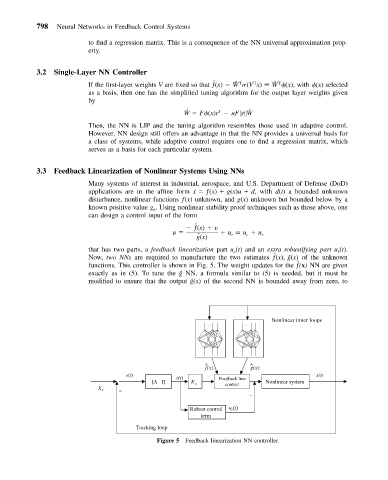
           3.3  Feedback Linearization of Nonlinear Systems Using NNs
                          Many systems of interest in industrial, aerospace, and U.S. Department of Defense (DoD)
                          applications are in the affine form ˙x   ƒ(x)   g(x)u   d , with d(t) a bounded unknown
                          disturbance, nonlinear functions ƒ(x) unknown, and g(x) unknown but bounded below by a
                          known positive value g . Using nonlinear stability proof techniques such as those above, one
                                            b
                          can design a control input of the form
                                                       ˆ
                                                       ƒ(x)   v
                                                 u              u   u   u r
                                                                 r
                                                                     c
                                                        ˆ
                                                        g(x)
                                                                  (t) and an extra robustifying part u (t).
                          that has two parts, a feedback linearization part u c                r
                                                                             ˆ
                          Now, two NNs are required to manufacture the two estimates ƒ(x), ˆg(x)  of the unknown
                                                                                   ˆ
                          functions. This controller is shown in Fig. 5. The weight updates for the ƒ(x)  NN are given
                          exactly as in (5). To tune the ˆg  NN, a formula similar to (5) is needed, but it must be
                          modified to ensure that the output ˆg(x)  of the second NN is bounded away from zero, to
                                                                            N Nonlinear inner loops


                                                          ^ ^ ^        ^^ ^
                                                                       ()
                                                          f(x) ) )     g(x)()
                                     ()
                                                                                          ()
                                    e(t)          r(t) )                                 x(t)
                                           [Λ    I]           Feedback line  Nonlinear r system
                                                                               e
                                                                              in
                                                                                a
                                                                             n
                                                                           N
                                                                            o
                                           [Λ   I]
                                                                             l
                                                                cont
                                                                control l
                                                      K v
                                                                  o
                                                                  r
                            X d
                                                                  ()
                                                      R o b u s t  u r (t)
                                                      Robust  control
                                                         term
                                         c
                                       Tra
                                       Tracking loop
                                          i
                                          k
                                             Figure 5 Feedback linearization NN controller.

